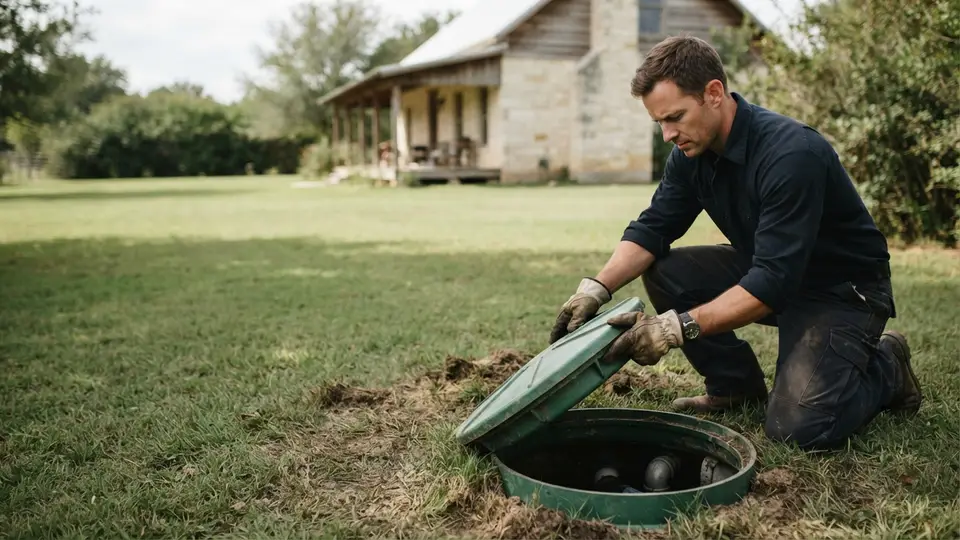
Conventional tank and field
Where it fits: Well-drained soil
What it needs: Pumping and field checks
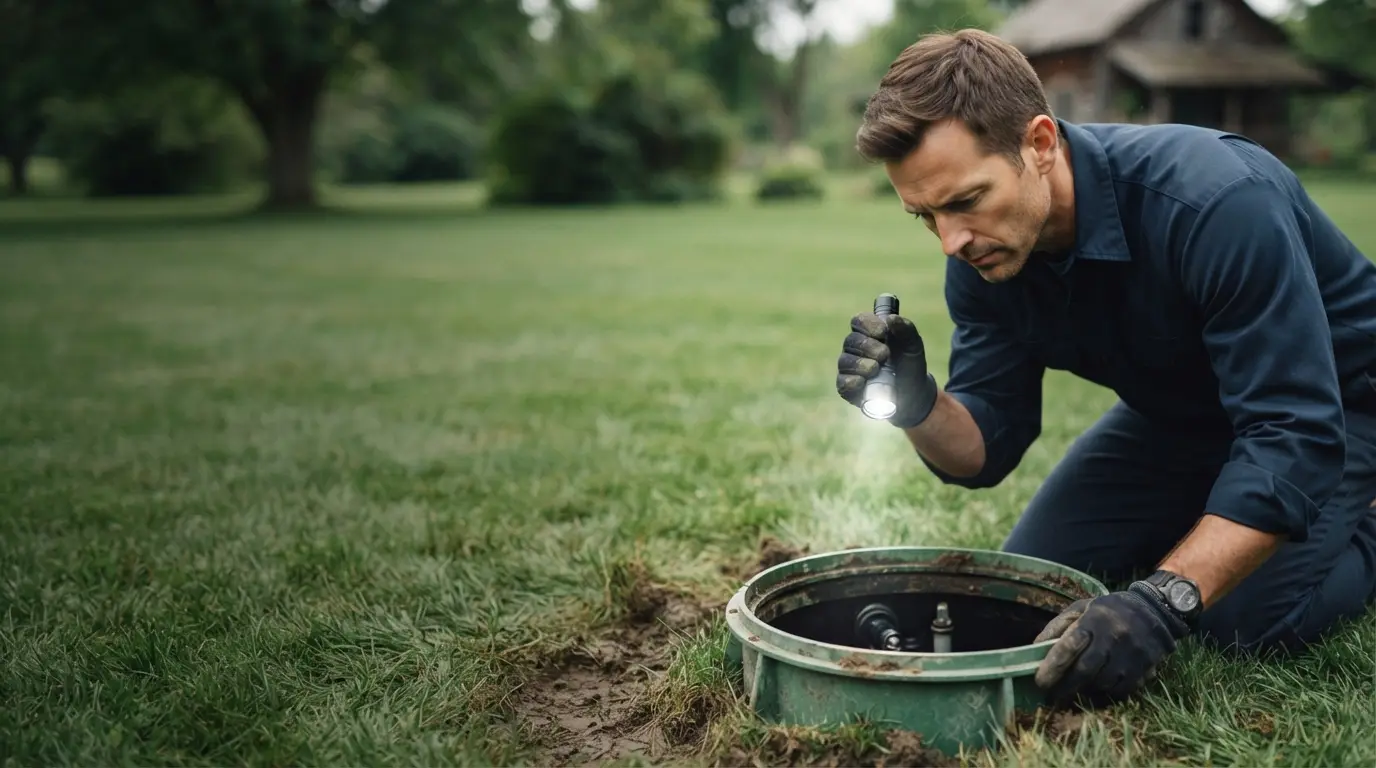
Every drain slow at once, or wet ground over the drain field? We handle septic tank services in Nebraska. Our plumbers pump tanks, inspect systems for home sales and repair or replace drain fields on acreages, farmsteads, lake homes and ranches. Nebraska septic systems deal with heavy clay in the east, sandy soils and high water tables along the Platte and in the Sandhills, deep winter frost and groundwater that many neighbours drink from. We find out why the system is struggling and give you a written price for the fix.
The service
A septic system holds household waste in a buried tank, where solids settle and scum floats. Clearer effluent flows to a drain field, where the soil filters it before it reaches groundwater. Where the soil is too tight, too sandy or too close to the water table, Nebraska systems may use pressure distribution, sand mounds or lagoons.
Acreage subdivisions around Omaha and Lincoln, such as those near Bennington (median build year 2002), Gretna and Hickman, often rely on septic, and nearly every farmstead and ranch does. Beaver Lake, a lake community in Cass County, has homes on small lots near the water.
Septic systems we service
Where it fits: Well-drained soil
What it needs: Pumping and field checks
Where it fits: Tight or uneven soil
What it needs: Pump, floats and alarm checks
Where it fits: High water table, shallow soil
What it needs: Pump service, surface checks
Where it fits: Some rural sites with room
What it needs: Vegetation and level checks
Why Nebraska
Clay soils around Omaha and Lincoln absorb effluent slowly and flood in wet springs.
Along the Platte and in the Sandhills, groundwater sits close to the drain field.
Shallow lines and thin snow cover let frost reach pipes in deep cold.
Solids carried out of a full tank clog the field.
Warning signs
Our process
We uncover the lids, pump both compartments, check baffles and the outlet filter and record sludge and scum levels so you know when to pump next.
For a home sale or a problem system, we check the tank, the pump and alarm if there is one, distribution and the field, and write up what we find.
We repair crushed, frozen or blocked lines and replace distribution boxes. When a field has failed, the replacement is designed and registered under state rules.
Typical cost
Any price before we see the system is an estimate only. The real figure depends on:
You get a written price, and nothing starts until you approve it.
Get a written price: (833) 733-2357Buried or snow-covered lids take time.
Pressure systems and mounds have more parts.
Clay and high groundwater complicate field work.
Repairing lines costs far less than a new field.
Remote ranches take longer to reach.
Benefits
Pumping keeps solids out of the field.
A working system protects groundwater.
Inspections find problems before backups.
Records and an inspection report reassure buyers.
Nearly all rural Nebraskans drink groundwater, and nitrate is already a concern in many wells across farm country. A failing septic system adds nitrate and bacteria close to home. In sandy soils along the Platte and in the Sandhills, effluent can reach shallow groundwater quickly. Keeping a system pumped, sized for the household and well away from the well protects your water and your neighbours'. If a field has failed, we recommend testing the well after the repair.
Acreage homes near Waverly (1,548 homes), Hickman, Bennington and Gretna often sit on clay soil with systems designed decades ago for smaller households. Owners who moved from city sewer may not know where the tank is or when it was last pumped. We locate and map the system, pump and inspect it and explain what to keep off the drain field so it lasts.
In Valentine, 24% of homes are vacant and propane heats 25%, a sign of how rural much of north-central Nebraska is. Sandhills soils drain fast and groundwater is close, so systems there need careful siting. Lake homes at Beaver Lake, Lake McConaughy and other lakes sit near water too. We pump, inspect and repair systems on ranches and lake lots and plan the drive so the visit covers everything needed.
Homes outside Grand Island (21,503 homes), Kearney, Lexington and North Platte often sit on sandy river soils with groundwater only a few feet down in wet years. A conventional field there may not have enough dry soil beneath it to treat effluent, and spring high water can flood it. We check groundwater depth when a field struggles and repair or redesign it, sometimes as a mound, so it works through the wet season.
Cut water use: delay laundry, run the dishwasher later and keep showers short. If a pump alarm is sounding, silence it but leave the pump circuit on.
Keep vehicles off the tank and field and keep people and pets away from wet or sewage-covered ground. Never open or enter a septic tank yourself. Then call us.
Onsite wastewater systems in Nebraska are regulated by the Department of Environment and Energy, which sets construction rules, registers systems and certifies onsite professionals. Some counties add their own requirements. We handle the paperwork on new systems and major repairs. Our plumbers hold the licenses and certifications each job requires.
Why choose us
What you can count on every time one of our plumbers comes to your door.
Every job is handled by a plumber who holds the license your state or city requires, backed by liability insurance.
Our plumber explains the problem and the options, and you approve a written price before any work begins.
Burst pipes, sewage backups and failed water heaters get priority scheduling, including nights and weekends.
We pull permits when the job needs one and schedule the inspection, so the work holds up when you sell.
Repairs and installations come with a written warranty on labor, on top of the manufacturer's warranty on parts.
Our pages and plumbers account for your area's water, soil, climate and the age of the homes around you.
Service area
We service septic systems around 593 Nebraska communities, including Kearney (14,750 homes) and Norfolk (11,786 homes). Find yours:
It depends on tank size, how deep the lids are buried and how far we travel. We give you a written price before we start pumping.
Usually, yes. If only a few lines are crushed or frozen, repairs cost much less. A field saturated throughout often needs replacing.
Yes. An inspection is priced on its own, and a full report for a home sale covers the tank, pump, distribution and field.
We uncover and pump the tank, check the baffles, filter, pump and alarm, open the distribution box and walk the field for wet spots.
Yes. We trace the line out from the house with a locator and probe the ground until we find the tank lids.
We test the soil and lines, repair damaged sections or design a replacement that meets state rules and is registered properly.
No. Septic gases can overcome a person quickly, and old lids can collapse. Leave opening and entering the tank to us.
Yes, especially in sandy soil with shallow groundwater. Fix a failing system quickly and test the well afterward for nitrate and bacteria.
Pumping a typical tank takes about an hour once the lids are uncovered. Buried lids, snow or inspections add time.
Design and registration can take a few weeks. The installation itself often takes a few days, depending on soil and weather.
Every three to five years for most homes. Larger households, rentals or homes with a disposal may need it more often.
Most systems do not need them. Regular pumping and keeping grease and chemicals out of drains matter far more than any additive.
Keep people and pets away, cut water use to a minimum and call us. Surfacing sewage is a health hazard and needs prompt work.
The Nebraska Department of Environment and Energy sets the rules and certifies onsite professionals. Some counties add their own requirements.
Nitrate from fertilizer and septic systems reaches groundwater in many farming areas. Test your well yearly and keep your septic system working.