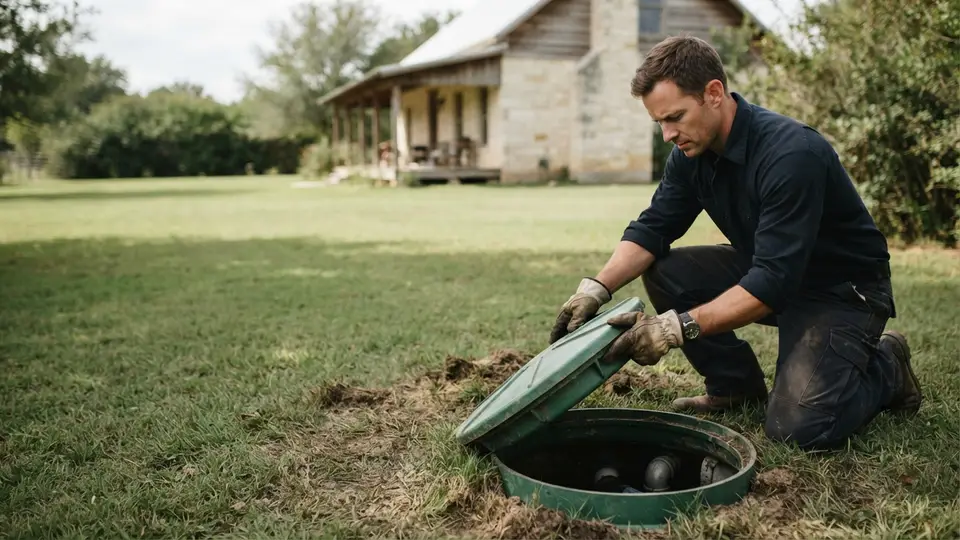
Conventional tank and lateral lines
Where it fits: Deeper, well-drained soil
What it needs: Pumping and field checks
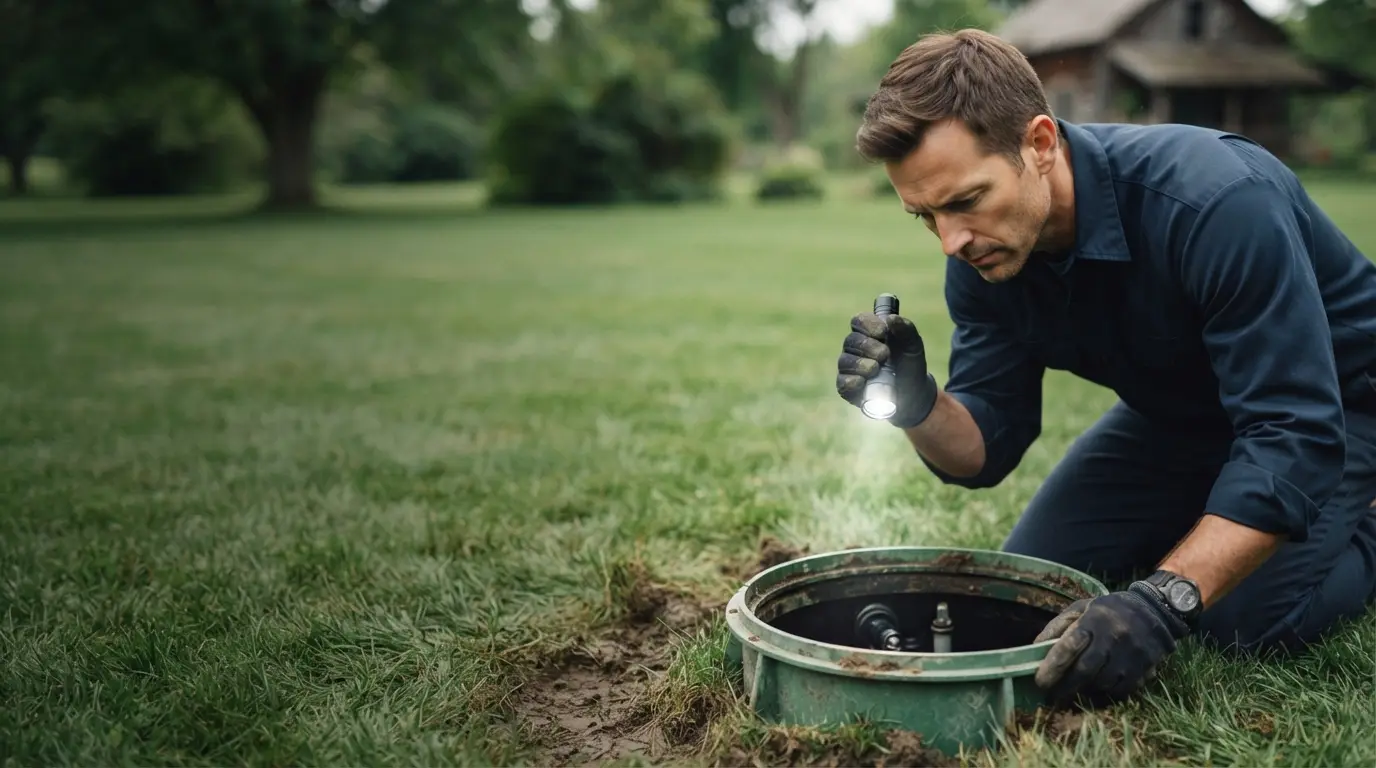
Soggy ground over the lateral field, or every drain slow after rain? We handle septic tank services in Missouri. Our plumbers pump tanks, inspect systems for home sales and repair or rebuild drain fields across the Ozarks, the lake country, the river hills and the farm counties of the north. Missouri septic work deals with thin rocky soil over limestone, tight clay in the north and west, and lake homes that see heavy use in summer and none in winter. We find out why your system is struggling and give you a written price for the fix.
The service
A septic system holds household waste in a buried tank, where solids settle and scum floats. Clearer effluent flows out to a soil absorption field, often called lateral lines in Missouri, where the soil filters it. Some sites with poor soil use low-pressure pipe systems, drip lines or aerobic treatment units instead.
Outside the sewer districts of St. Louis, Kansas City, Springfield and the bigger towns, septic is the norm. Even in Wildwood, an outer St. Louis County suburb with a median build year of 1992, many homes sit on larger lots with their own systems. In the Ozarks, nearly every rural home has one.
Septic system types we service
Where it fits: Deeper, well-drained soil
What it needs: Pumping and field checks
Where it fits: Shallow or rocky soil
What it needs: Pump, floats and alarm checks
Where it fits: Poor soils, small lots
What it needs: Aerator service and maintenance
Where it fits: Thin soil over rock
What it needs: Filter cleaning and zone checks
Why Missouri
Across the Ozarks, limestone and chert lie close to the surface and leave little soil to treat effluent.
Clay in northern and western Missouri absorbs water slowly, and fields flood in wet springs.
Solids carried out of an overfull tank clog the lateral lines.
Lake homes and rentals fill with guests in summer, far beyond what older systems were built for.
Warning signs
Our process
We uncover the lids, pump both compartments, check the baffles and outlet filter and note the scum and sludge levels, so you know when the next pumping is due.
For a home sale or a problem system, we check the tank, the pump and alarm if there is one, the distribution box and the field, and we write up what we found.
We repair crushed or blocked lines, replace distribution boxes and, when a field has failed, design a replacement with the county or state health office.
Typical cost
Any price discussed before we see the system is an estimate only. The real figure depends on:
You get a written price, and nothing starts until you approve it.
Get a written price: (833) 733-2357Buried lids take time to uncover.
Pressure and aerobic systems have more parts to check.
Ozark rock and wet clay make field work harder.
Repairing a few lines costs far less than a new field.
New fields need approval before work begins.
Benefits
Pumping keeps solids out of the lateral lines.
A working system treats effluent before it reaches rock.
Problems show up in an inspection before a backup.
Records and an inspection report reassure buyers.
In Texas County, propane heats 57% of homes in Houston, a sign of how far many Ozark homes are from utility lines. The same homes rely on septic and wells. Mountain View and Thayer, in the hills near the Arkansas line, are much the same. Ground here is full of springs, losing streams and sinkholes, and effluent that reaches fractured rock can travel into wells quickly. We keep systems pumped and working, and when a field fails we look at shallow-soil designs the health office accepts.
57% of homes in Osage Beach and 50% in Lake Ozark are vacant on any given day, mostly second homes and rentals. Branson (9,006 homes) and the towns around Table Rock Lake have many seasonal and rental homes too. A system sized for a couple can struggle with a full house every summer weekend. We pump before and after the busy season, check grinder pumps on homes that pump uphill to a sewer or tank and repair lines damaged by steep, rocky lots.
Manufactured homes make up 37% of homes in Merriam Woods, near Branson, and much of the housing in some rural communities. Many sit on older septic tanks installed for an earlier home on the same lot. The tank may be smaller than today's rules require, or its location may be unknown. We find and uncover the tank, pump and inspect it and tell you whether it can keep serving the home.
Cut water use: postpone laundry, run the dishwasher later and take short showers. If an alarm is sounding on a pump system, silence it but do not switch off the pump circuit.
Keep vehicles off the tank and field, and keep people and pets away from any wet or sewage-covered ground. Never open or enter a septic tank yourself; the gases are dangerous. Then call us.
Onsite wastewater systems in Missouri are regulated by the Department of Health and Senior Services together with county health departments, and some counties have their own ordinances. New systems and major repairs need approval first. We file the paperwork and schedule inspections. Our plumbers hold the licenses each job requires.
Why choose us
What you can count on every time one of our plumbers comes to your door.
Every job is handled by a plumber who holds the license your state or city requires, backed by liability insurance.
Our plumber explains the problem and the options, and you approve a written price before any work begins.
Burst pipes, sewage backups and failed water heaters get priority scheduling, including nights and weekends.
We pull permits when the job needs one and schedule the inspection, so the work holds up when you sell.
Repairs and installations come with a written warranty on labor, on top of the manufacturer's warranty on parts.
Our pages and plumbers account for your area's water, soil, climate and the age of the homes around you.
Service area
We service septic systems around 1,082 Missouri communities, from Rolla (9,238 homes) and Farmington to Nixa (9,415 homes). Find yours:
It depends on tank size, how deep the lids are buried and how far we travel. We give you a written price before we start pumping.
Usually, yes. If only a few lines are crushed or blocked, repairing them costs much less. A field saturated throughout often needs replacing.
Yes. An inspection is priced on its own, and a full report for a home sale includes the tank, pump, distribution and field.
We uncover and pump the tank, check baffles, pump, floats and alarm, open the distribution box and walk the field for wet spots.
Yes. We trace the sewer line out from the house with a locator and probe the ground until we find the tank lids.
We test the soil and lines, then repair damaged sections or design a new field with approval from the county or state health office.
No. Septic gases can overcome a person quickly, and old lids can collapse. Leave opening and entering the tank to us.
Yes, especially in Ozark karst, where effluent can move through cracked rock. Fix a failing system quickly and test the well afterward.
Pumping a typical household tank takes about an hour once the lids are uncovered. Inspections and digging out buried lids add time.
Design and approval can take a few weeks. The installation itself often takes a few days, depending on rock and weather.
Every three to five years for most homes. A busy household, a rental or a home with a disposal may need it more often.
Most systems do not need them. Regular pumping and keeping grease and chemicals out of drains matters far more than any additive.
Keep people and pets away, cut water use to a minimum and call us. Surfacing sewage is a health hazard and needs prompt work.
Thin soil over limestone gives little room to treat effluent, and cracks carry it to groundwater. Systems there must be sized and maintained carefully.
Often, yes. A full house every weekend overloads older systems, so pumping before the busy season helps the field cope.