Meter or pressure tank test
What it reveals: Whether water is escaping with all fixtures off
Water bill doubled, or a stain spreading across the ceiling? We provide leak detection and repair in Delaware, with small, targeted openings. Delaware leaks come from aging galvanized and copper in older homes, pinholes caused by acidic well water, freeze damage in empty beach houses and worn fixture connections. Finished basements and slab floors hide many of them. We find the leak with pressure tests, listening equipment and thermal imaging, then repair it and check the meter. Here is how we work and what affects the cost.
The service
We search for leaks in supply lines, drain lines, fixtures, water heaters, outdoor showers, irrigation lines and the buried service line or well line. Once located, we open only what is needed, repair it, and confirm the fix with a pressure test and a meter or pressure tank check.
How we find leaks
What it reveals: Whether water is escaping with all fixtures off
What it reveals: Which branch, hot or cold, inside or outside, is leaking
What it reveals: Escaping water under floors, in walls or underground
What it reveals: Warm or cool spots from leaking lines behind finishes
What it reveals: How far water has spread into drywall and framing
Why Delaware
48% of the homes in our Delaware data predate 1980, 79% in Wilmington and 54% in Newark. Galvanized steel corrodes at joints and older copper develops pinholes.
Wells in parts of Kent and Sussex County produce water with low pH, which slowly dissolves copper. Blue-green stains and pinhole leaks are the signs.
Beach homes left empty in winter freeze when heat fails. Census counts only 461 of Bethany Beach's 2,605 homes as occupied year-round, so many sit empty through cold snaps.
Outdoor shower valves and irrigation lines that were not drained crack in winter and leak when turned on in spring.
Warning signs
Our process
We check the meter or watch the well pressure with all fixtures off.
Testing hot, cold, indoor and outdoor lines separately narrows the search.
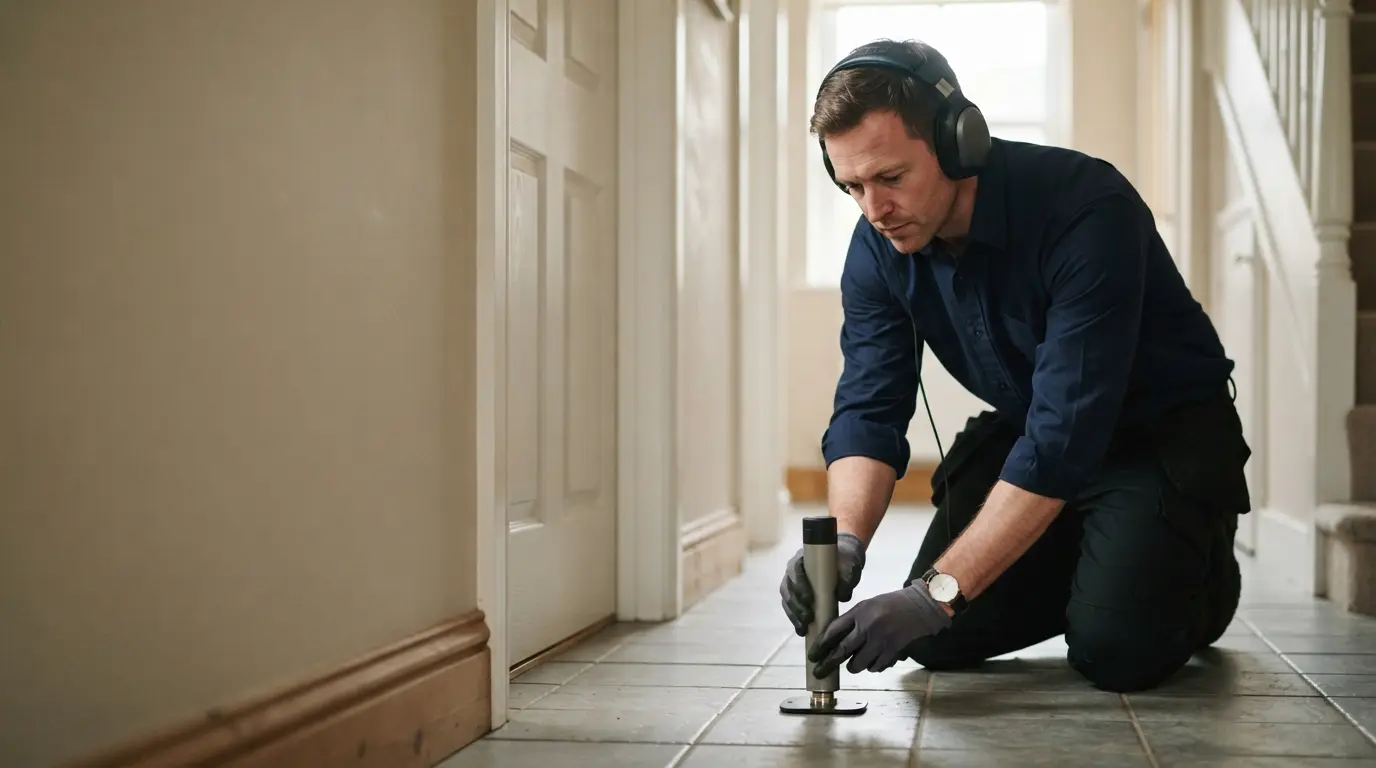
Listening equipment and thermal imaging find the spot.
You approve a written price before we open anything.
We fix it, pressure test and recheck.
Typical cost
You approve a written price before work begins.
Get a written price: (833) 733-2357Exposed pipe is quick; leaks under slabs or behind finishes take longer.
Tile and finished basements cost more to open.
Freeze damage can involve several.
Corroded pipe may need a longer section replaced or a repipe.
After-hours calls cost more.
Benefits
We open one access point instead of whole walls.
Ending a continuous leak saves water and pump wear.
Early repair protects framing and finishes.
Photos and notes support a claim.
For frozen pipes, we find the frozen section, thaw it with controlled heat and check it for splits before restoring pressure. For burst pipes, we shut off the water, replace the damaged section and check the rest of the run, since freezes often split more than one spot. Where a line keeps freezing, such as in a crawl space or an exterior wall, we reroute or insulate it.
Owners in Ocean View, where the median home was built in 2006, Bethany Beach and other shore towns often check on their homes only occasionally in winter. We winterize systems, install automatic shutoff valves that close the main when they detect a leak, and add temperature and water sensors that alert you by phone. In spring, we de-winterize carefully and test for freeze damage before restoring full pressure.
Homes on wells have no meter, but a leak shows up as a pump that cycles when no one is using water. A leak can also be in the buried line from the well to the house. We test the system in sections, locate the leak and repair it, and check the pressure tank and pump while we are there.
Many northern Delaware homes have finished basements, and many newer homes in Kent and Sussex sit on slabs. In a finished basement, a slow leak from an upstairs bathroom or a supply line in the ceiling can soak insulation and carpet before anyone notices. Under a slab, water can run into the ground for months. Thermal imaging, moisture readings and acoustic listening let us find these leaks without opening large areas, and we can often reroute a line through a ceiling instead of breaking a floor.
Renters occupy 53% of homes in Dover and 49% in Newark. Tenants may not notice a slow leak or may not report it right away. We find and fix leaks for landlords, document the cause and suggest simple upgrades, such as braided supply lines and leak sensors, that cut the risk between inspections.
Close the main shutoff, or for a well home switch off the well pump breaker. Turn off the water heater. Stay away from wet electrical outlets and fixtures.
Move belongings, take photos and, for a frozen pipe, open the faucet it serves. Never use an open flame on pipes. Then call us.
Most leak repairs need no permit. Repiping and service line replacement usually do, from your county or town. Our plumbers hold the Delaware licenses required, and we pull permits when needed.
Why choose us
What you can count on every time one of our plumbers comes to your door.
Every job is handled by a plumber who holds the license your state or city requires, backed by liability insurance.
Our plumber explains the problem and the options, and you approve a written price before any work begins.
Burst pipes, sewage backups and failed water heaters get priority scheduling, including nights and weekends.
We pull permits when the job needs one and schedule the inspection, so the work holds up when you sell.
Repairs and installations come with a written warranty on labor, on top of the manufacturer's warranty on parts.
Our pages and plumbers account for your area's water, soil, climate and the age of the homes around you.
Service area
We find and repair leaks in 79 Delaware places, from Dover (16,448 homes) to Hockessin and the beach towns. Choose yours:
It depends on the size of the home, where the leak is and the equipment needed. You receive a written price for the search before we begin.
Yes. After we locate the leak and see the pipe, we give a written price for the repair options before opening anything.
Almost always. Winterizing a shore home costs far less than repairing burst pipes and the water damage they cause.
Isolation tests narrow the leak to one line, and acoustic and thermal tools locate it. Then we open a small access point.
We watch the pressure tank and pump with all water off, then test sections of the system to find where water is escaping.
Yes. Flow-sensing shutoff valves close the main when they detect a leak, which helps empty and seasonal homes.
Close the main shutoff or switch off the well pump, turn off the water heater and avoid wet electrical areas. Then call us.
No. Open flames can crack pipe and start fires. Open the faucet and let us thaw it safely.
Many leaks are found within one to two hours. Slab and long buried lines can take longer.
Most repairs restore water the same visit, and we tell you how long it will be off before we start.
Test the pH. If the water is acidic, a neutralizer protects copper pipe from further corrosion.
Check the meter or well pump behavior every few months, and look under sinks and around the water heater each season.
Shut off the main, keep away from wet light fixtures and call us. Active leaks get priority scheduling.
Many sit empty in winter, and if heat fails during a cold snap, pipes in crawl spaces and exterior walls freeze and split.
Usually acidic water dissolving the copper, common with some Delaware wells. It leads to pinhole leaks over time.