PEX
Typical use: Most whole-house repipes, especially overhead reroutes
Notes: Flexible, fewer fittings, faster installation
Rust-colored water, or one slab leak after another? We handle repiping and water line replacement in California for homes whose pipe has run its course. More than half of California homes were built before 1980, and many still carry galvanized steel or thin copper that has been in service for 45 to 100 years. We fix isolated sections, repipe entire homes in PEX or copper with minimal wall openings, and replace the buried line from the meter. Below: when to repipe, how the work goes, and what drives the price.
The service
Pipe repair replaces a damaged length of pipe. A whole-house repipe replaces every hot and cold supply line from the main to the fixtures. Water line work covers the service line between the meter and the house, which in California is usually the owner's responsibility. On older homes we often do all three, since interior pipe and service line tend to be the same age.
Repipe materials
Typical use: Most whole-house repipes, especially overhead reroutes
Notes: Flexible, fewer fittings, faster installation
Typical use: Owners who prefer metal, exposed runs
Notes: Long service record, higher material cost
Typical use: Meter to house
Notes: Choice depends on soil, length and utility rules
Why California
27% of the California homes in our data were built before 1960, when galvanized steel was a standard supply pipe. The median home in San Francisco dates from 1946, in Long Beach from 1959 and in Los Angeles from 1965. Galvanized pipe rusts inward until flow drops to a trickle.
Postwar and later slab homes often have copper under the floor that wears through. Once several slab leaks have happened, rerouting the whole system overhead is usually the lasting fix.
Mineral-heavy water in Southern California and the inland valleys scales pipes and fittings, and some water conditions pit copper over time.
Decades of partial repairs leave galvanized, copper and plastic joined together. Where dissimilar metals meet without proper fittings, corrosion speeds up.
Warning signs
Our process
We note every fixture, the foundation type, attic access and the best routes for new pipe.
You approve the material, routes, schedule and price.
Floors and furniture are covered; work areas are kept tidy.
New pipe goes in while the old system still serves you; water is off only for connections.
Each fixture is connected with new shutoffs, the system is pressure tested and flushed, and we schedule the city inspection.
Access holes are patched to a paint-ready finish or as agreed in the price.
Typical cost
We give you a written price covering every part before work begins.
Get a written price: (833) 733-2357More bathrooms and longer runs mean more pipe and labor.
Crawl spaces are simplest; two-story slab homes are the most involved.
PEX usually costs less than copper.
How many openings and the finish level affect the price.
Length, depth and hardscape above it matter.
Most California cities require one for repiping.
Benefits
Full-diameter pipe restores flow to every fixture.
No more rust from corroded galvanized lines.
Overhead routing takes pipe out of the slab.
Each fixture can be isolated for future repairs.
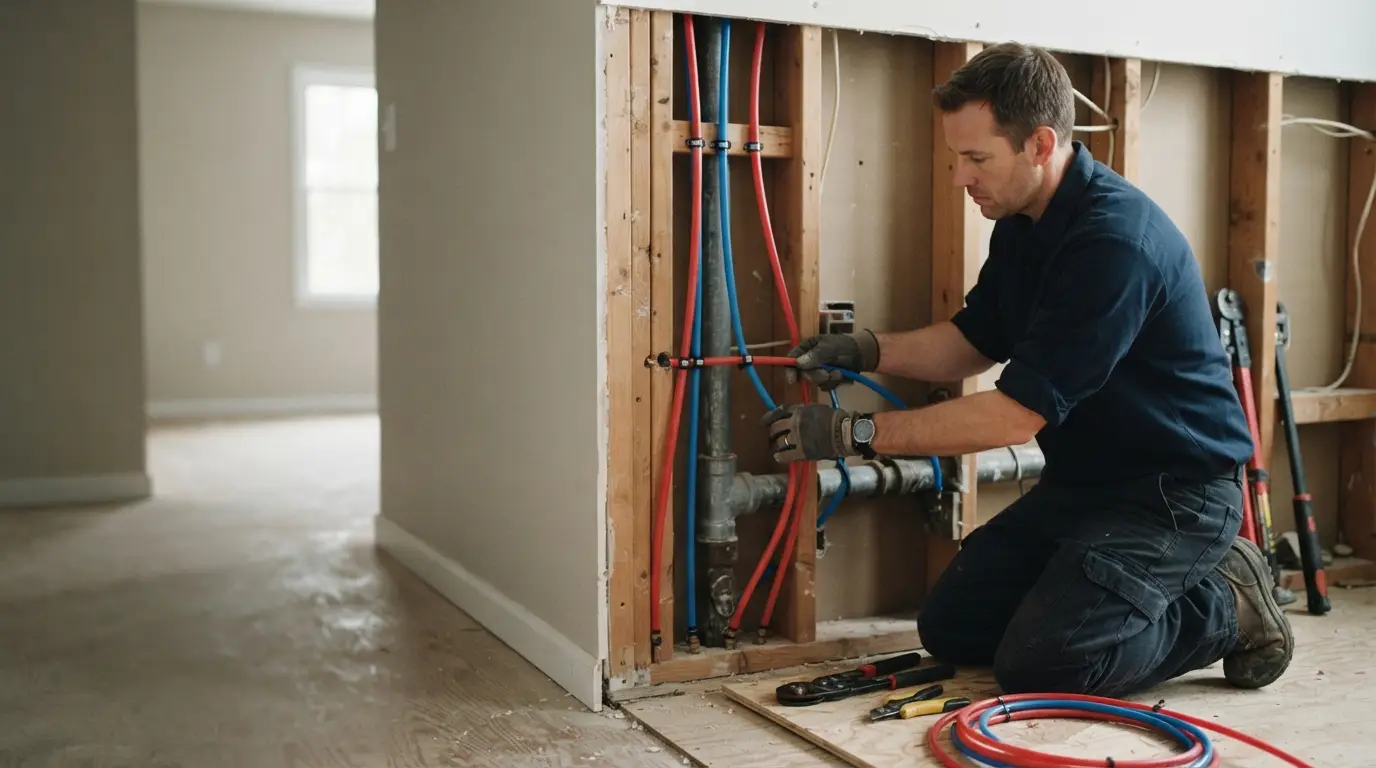
Raised-foundation homes, common in the Bay Area, older Los Angeles neighborhoods and many coastal towns, let us run most new pipe through the crawl space with short drops into walls, so few openings are needed. Slab homes are repiped overhead through the attic and down interior walls, with small openings at each fixture group. Two-story slab homes take more planning, and we explain the route before any cutting begins.
If you are opening walls for a kitchen or bathroom remodel, that is the cheapest moment to replace old supply pipe, since the access is already there. We coordinate with your contractor so new lines go in before insulation and drywall, set valves and stub-outs for the new fixture layout, and replace the rest of the house at the same time if you choose. Doing it together avoids cutting into new finishes later.
With 45% of California homes rented, many repipes are for landlords. In duplexes and small apartment buildings, we can phase the work unit by unit, keeping water on for occupied units and giving tenants a clear schedule. The property owner arranges access and notice; we handle the plumbing, permit and inspection.
A leaking or corroded service line shows up as a wet strip in the yard, a meter that moves with all water off or low pressure throughout the house. We trace the line, then repair a section or replace the full run by trenching or pulling new pipe through with minimal digging. Work at the meter is coordinated with your water utility, and the new line is pressure tested before it is buried.
If an old pipe is leaking, close the main shutoff gently; old gate valves can break when forced. If it will not turn, close the valve at the meter box with a meter key if you have one, or call us.
Write down which fixtures have the lowest pressure or discolored water. Clear access to the attic hatch, crawl space and water heater before our survey.
Whole-house repiping and service line replacement generally require a permit and inspection in California. Our California work is done under a C-36 plumbing contractor license. We pull the permit, schedule inspections and coordinate with the water utility for work at the meter.
Why choose us
What you can count on every time one of our plumbers comes to your door.
Every job is handled by a plumber who holds the license your state or city requires, backed by liability insurance.
Our plumber explains the problem and the options, and you approve a written price before any work begins.
Burst pipes, sewage backups and failed water heaters get priority scheduling, including nights and weekends.
We pull permits when the job needs one and schedule the inspection, so the work holds up when you sell.
Repairs and installations come with a written warranty on labor, on top of the manufacturer's warranty on parts.
Our pages and plumbers account for your area's water, soil, climate and the age of the homes around you.
Service area
We repipe homes in 1,618 California places, including Glendale (69% of homes before 1980), Garden Grove (77%) and Santa Barbara (74%). Choose yours:
It depends on home size, fixture count, foundation, stories, material and patching. After surveying the house, we give you a written price.
Usually. PEX costs less as material and installs faster with fewer fittings. Copper costs more but some owners prefer it.
By the length and depth of the line, what lies above it, the digging method and coordination with the utility. We trace it before pricing.
Usually yes. The old system works until we switch over, so water is off only for short connection periods each day.
Yes, access openings are patched as described in your written price, often to a paint-ready finish.
Yes. Every fixture gets a new shutoff, and the main valve is replaced if it is worn.
Corroded galvanized pipe causes rust, and older systems can contain lead in solder or fittings. A repipe removes that concern; a water test shows current levels.
No. Old valves can snap. Turn gently, and if it will not close, use the meter valve or call us.
Many single-story homes take two to four days, larger or two-story homes longer, plus inspection time.
Often a single day; longer for deep, long or hardscaped runs.
PEX and copper installed correctly should last for decades, especially with normal pressure and treated hard water.
If your water is hard, a softener protects new pipe, the water heater and fixtures from scale. We can test it.
Shut off the main and call us. We repair the break so you have water, and the repipe goes ahead as planned.
Many built before the 1960s still do, at least in part. Our Census data shows over a quarter of California homes predate 1960.
Yes, in most cities and counties. We pull it and schedule the inspection.