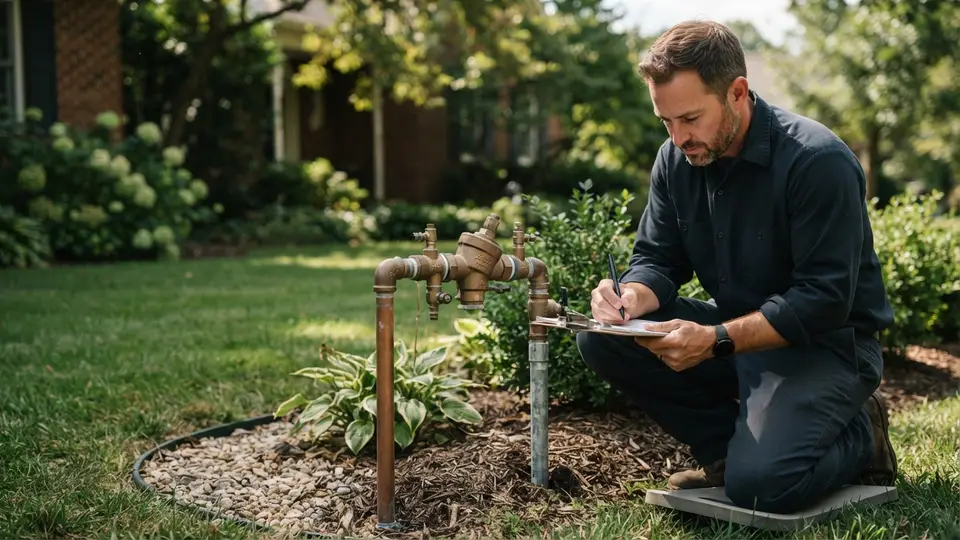
Reduced pressure principle (RP)
Common use: High-hazard uses, boilers, labs
Points to know: Relief port must drain freely
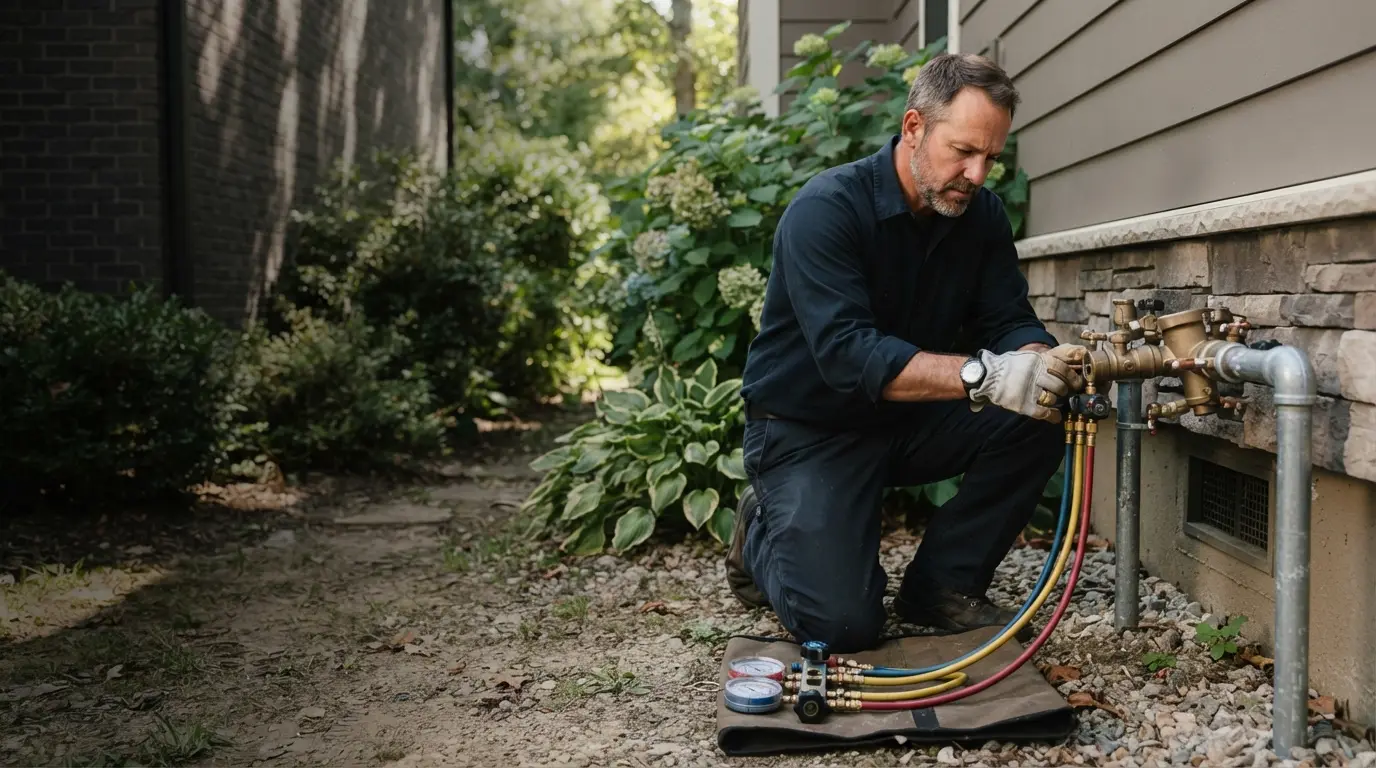
Yearly backflow test due, or a sprinkler valve split by frost? We do backflow testing and prevention in Indiana for homes, businesses and HOAs. Indiana water utilities keep cross-connection programs that require approved assemblies on lawn irrigation, fire sprinklers, boilers and many commercial connections, with regular tests by certified testers. Our team tests, installs, rebuilds and winterizes these devices and sends the paperwork to your water utility when it is required.
The service
Water is supposed to move one way: from the public main into your building. A main break, a fire hydrant opening or a pump in your building can reverse that flow, pulling lawn chemicals, boiler treatment or soapy process water back toward the public supply. A backflow assembly is a set of check valves and, on the strongest designs, a relief valve that blocks that reversal. Indiana rules call for protection on hazardous connections, and each water utility sets its own testing requirements.
Assemblies we see most
Common use: High-hazard uses, boilers, labs
Points to know: Relief port must drain freely
Common use: Fire lines, lower hazards
Points to know: Often in a pit or mechanical room
Common use: Lawn sprinklers
Points to know: Mounted above the highest head
Common use: Outdoor faucets
Points to know: Cheap, simple protection
Why Indiana
Outdoor sprinkler assemblies that are not drained split their bodies in the first hard freeze.
Scale and iron deposits keep check discs from seating.
Discs, seals and diaphragms harden with years of temperature swings.
Sand and grit after utility repairs lodge in the checks.
Warning signs
Our process
A certified tester connects a differential gauge kit to the test cocks, checks each valve and the relief opening, logs the readings and files the report your utility asks for.
The right assembly for the hazard is installed where it can be drained, tested and kept from freezing, with a permit.
Failed devices get new discs, springs and seals, or a new body if cracked, followed by a retest.
Typical cost
You approve a written price before we begin.
Get a written price: (833) 733-2357Several at one site cost less each.
Large RPs take longer to test and rebuild.
Kits cost less than new bodies.
Startups and shutdowns are priced separately.
New installs need one.
Benefits
Your connection cannot contaminate the system.
Tests filed on time.
Proper fall shutdown.
Every assembly tracked.
Irrigation systems are everywhere in Carmel (40,859 homes), Fishers, Westfield and Noblesville, and each needs a backflow assembly. Many local utilities require yearly tests. We combine the spring startup with the test, then drain the assembly and blow out the zones in fall so nothing splits over winter.
Before the first hard freeze, the irrigation supply is closed, the assembly drained through its test cocks, the zones blown out with compressed air and the valves left half-open. This simple routine prevents the cracked brass bodies we replace every April.
Older homes and apartment buildings in Indianapolis (401,428 homes in the city), Fort Wayne and South Bend often heat with boilers that hold treated water. The fill line needs an approved device so that water cannot flow back into the drinking supply. We install and test them.
Businesses in Evansville (59,180 homes), Bloomington and Greenwood need protection on beverage systems, dishwashers, chemical dispensers, dental and medical equipment and wash bays. We test every assembly at a site together and keep a record of each.
Fire sprinkler water sits in the pipes for years and must never mix with drinking water. Fire line assemblies are tested like the others, and we coordinate with the fire protection contractor whenever the system has to be shut down.
Utilities track every assembly they require, and missed tests can lead to notices and eventually shutoff. We log each device we test with its location, size, serial number and readings, and send a reminder before the next one is due. HOAs and multi-site businesses get a single list.
A backflow device on the main service makes the house a closed system. Water expanding in the heater has nowhere to go, so the relief valve drips. An expansion tank solves it, and we check for one whenever we install a main-line device.
A hose left in a bucket of weed killer, a laundry tub faucet with a hose dropped into dirty water, or a softener drain line pushed into a floor drain without an air gap can each create a path back into your pipes. We point these out and fix them with vacuum breakers or proper air gaps.
Subdivision associations often run irrigation at entrances, ponds and common grounds, each with its own assembly and sometimes its own meter. Due dates can differ. We test them together on one visit where we can, give the board a single report and handle spring startup and fall shutdown so nothing cracks over the winter. If a device fails, we explain the repair and price it in writing before any work.
Some commercial buildings and older apartment complexes keep their backflow assemblies in underground pits or meter vaults. These flood, and an RP should never sit where its relief port can be submerged, because that defeats the point of the valve. When we find one, we explain the options for moving it to a heated room or an insulated, drained enclosure above ground.
When a storefront becomes a restaurant, salon or clinic, the utility may require a different assembly. We review the plans, install the right device during the build-out and test it before opening day, so the backflow item does not hold up your occupancy inspection. We leave the test report and permit record with you for the health and building inspectors, who often ask to see both before they sign off on the space and let you open.
If a sprinkler assembly is spraying, close the irrigation shutoff, usually in the basement near the main. Never plug an RP relief port.
Have your utility notice handy and clear a path to the device. Then call us.
New assemblies need a permit and must be approved types. Tests are performed by testers certified under Indiana rules. Our plumbers hold the licenses Indiana requires.
Why choose us
What you can count on every time one of our plumbers comes to your door.
Every job is handled by a plumber who holds the license your state or city requires, backed by liability insurance.
Our plumber explains the problem and the options, and you approve a written price before any work begins.
Burst pipes, sewage backups and failed water heaters get priority scheduling, including nights and weekends.
We pull permits when the job needs one and schedule the inspection, so the work holds up when you sell.
Repairs and installations come with a written warranty on labor, on top of the manufacturer's warranty on parts.
Our pages and plumbers account for your area's water, soil, climate and the age of the homes around you.
Service area
We test and install backflow assemblies in 976 Indiana communities. Choose yours:
It depends on how many devices you have and their size and type. Several at one site lower the per-device cost.
A split body usually means a new assembly. Size and model set the price.
Yes, though many customers bundle it with the spring test and startup.
Our certified tester attaches gauges to the test cocks and checks each check valve and relief opening.
Yes, where required, and you keep a copy.
Yes. The fill line needs approved protection to keep treated water out of the supply.
Yes. It can carry fertilizer, chemicals or bacteria into drinking water lines.
No. The discharge is a safety feature. Call us to find the cause.
Usually under an hour for each assembly.
Your utility sets the date, usually once a year.
Before the first hard freeze, typically in October.
Whenever they fail a test or show wear.
Close the irrigation shutoff and call us.
State rules require protection, and each water utility runs its own testing program.
Water left in the outdoor assembly freezes and splits the brass.