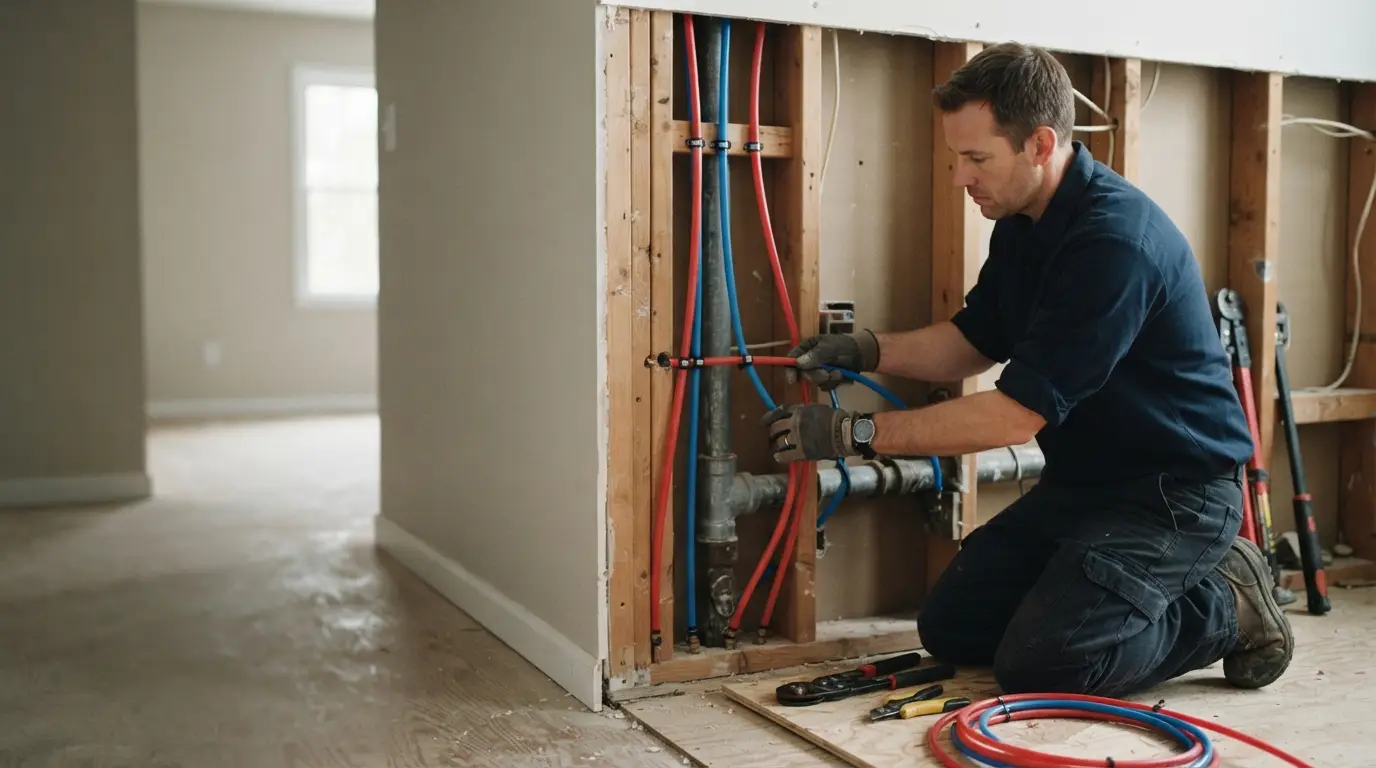
PEX
Why choose it: Flexible, few fittings, handles a freeze better
Trade-offs: Must be kept out of sunlight
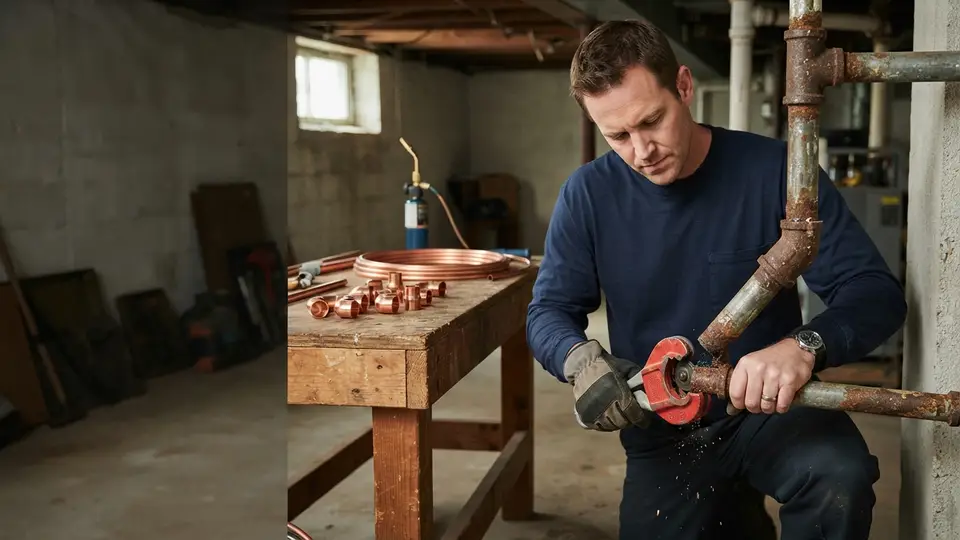
Brown water from galvanized pipe, or a trickle upstairs? We do repiping and water line replacement in Indiana for houses and small apartment buildings. Steel-mill towns in the Region, factory cities like Anderson and Muncie and county seats across the state are full of homes still running on galvanized supply lines, with copper patches from decades of repairs. Hard water speeds the decline. We replace the whole system or just the line from the meter, sized for the way you use water today.
The service
35% of Indiana homes in our data were built before 1960. In East Chicago the median home dates from 1938, in Logansport from 1943 and in Hammond from 1952. Homes of that age were plumbed with galvanized steel, which closes up with rust from the inside. Repiping swaps it for modern pipe and new valves at every fixture.
Pipe choices
Why choose it: Flexible, few fittings, handles a freeze better
Trade-offs: Must be kept out of sunlight
Why choose it: Proven over decades
Trade-offs: Higher cost; hard water can pit it
Why choose it: Will not rust
Trade-offs: Gets brittle with age
Why Indiana
The zinc coating wears away and rust fills the bore until flow is a fraction of what it was.
Scale lines the pipe and wears out every valve and faucet cartridge.
Copper screwed straight into steel corrodes quickly at the joint.
Each winter repair adds fittings that become future leak points.
Warning signs
Our process
One bad section in otherwise healthy pipe is cut out and replaced with matching material and the right transition fittings.
We plan routes to each fixture, install new lines and stop valves, connect and pressure test, then disconnect the old steel.
A leak in the line from the meter is located and the damaged length replaced.
A failing service line is replaced below frost depth, by trench or by pulling new pipe through the old path.
Typical cost
You approve a written price before any pipe is cut.
Get a written price: (833) 733-2357More baths mean more runs.
PEX usually costs less than copper.
Plaster takes more work than drywall.
Longer and harder digs cost more.
Needed for repiping and service lines.
Benefits
No more rust from steel lines.
Every floor gets full flow.
New pipe and fittings throughout.
Buyers and inspectors look for it.
Gary (37,816 homes), Hammond, East Chicago and Michigan City are full of houses from the steel boom. Most have basements, which makes repiping practical: we run new trunk lines along the basement ceiling and branch up to each fixture with small wall openings. Two-flats get a separate shutoff for each unit.
In Anderson (27,483 homes), Marion, Richmond, Terre Haute and Vincennes, where 76% of homes predate 1980, many houses were built for workers in the first half of the 1900s. We often find original galvanized lines with a few later copper repairs. A full repipe usually takes a few days and removes the rust problem for good.
The service line feeding an older house may be galvanized, early copper or, in some cities, lead. Indiana utilities have been inventorying service line materials under federal rules; your utility can tell you what it has on record. We replace the private portion of the line, coordinate with the utility on the public side and bury the new line below frost.
Around Bedford (6,828 homes) and Bloomington, limestone sits close to the surface. Replacing a service line there can mean rock trenching, so we plan the route to avoid the hardest ground where we can.
A repipe is the moment to move water lines out of outside walls and crawl space corners. We keep new runs inside the heated envelope, insulate any that pass near cold spots and fit frost-free outdoor faucets with inside shutoffs.
Every repipe includes a working main shutoff, quarter-turn stops at fixtures and, where the system needs them, a pressure-reducing valve and expansion tank. Old gate valves in Indiana basements are often stuck open; new valves mean one leak never shuts down the whole house.
If you are opening walls in an older Indianapolis (401,428 homes in the city) or South Bend house for a new kitchen or bath, replace the supply and drain pipe at the same time. It costs far less than opening those walls again later.
Northern Indiana has many manufactured homes, 12% of housing in Goshen and 9% in Elkhart. Older units often have polybutylene or thin plastic lines under the floor that crack in a hard freeze. We repipe them in PEX from below, add heat tape where lines run near the skirting and replace the riser from the ground with an insulated one.
If your house has old galvanized pipe that once sat downstream of a lead service line, or copper joined with lead solder, a certified lab test shows what is reaching your tap. Testing before and after a repipe documents the improvement for your records. Until then, run the cold tap for a few minutes after water sits overnight and use cold water for cooking.
Inspectors in older Indiana neighborhoods note galvanized supply right away, and buyers often ask for a credit. Repiping first removes the issue, and we provide permit records you can share with the buyer and their inspector. A clean repipe record often keeps negotiations simple and the closing on schedule, especially in older neighborhoods where nearly every listing raises the same question about the pipes behind the walls.
For an active leak, close the main valve or the fixture stop. Learn where your main is now, before you need it.
Make room in the basement and under sinks so we can reach the pipe. Then call us.
Repiping and service line work require permits and inspections, which we obtain. Our plumbers hold the licenses Indiana requires.
Why choose us
What you can count on every time one of our plumbers comes to your door.
Every job is handled by a plumber who holds the license your state or city requires, backed by liability insurance.
Our plumber explains the problem and the options, and you approve a written price before any work begins.
Burst pipes, sewage backups and failed water heaters get priority scheduling, including nights and weekends.
We pull permits when the job needs one and schedule the inspection, so the work holds up when you sell.
Repairs and installations come with a written warranty on labor, on top of the manufacturer's warranty on parts.
Our pages and plumbers account for your area's water, soil, climate and the age of the homes around you.
Service area
We repipe homes and replace water lines in 976 Indiana communities, from South Bend (47,775 homes) to Terre Haute. Choose yours:
House size, fixture count, pipe type and wall repair set the price. We write it up after walking the house.
Length, depth, rock and any street work drive the cost. We look at the route first.
PEX usually costs less to install and handles a freeze better. Copper is available if you prefer it.
As little as possible. Basements and closets let us run most pipe out of sight.
Exposed pipe is removed; pipe sealed in walls is disconnected and left.
Yes, with a separate shutoff for each unit and notice for tenants.
Mostly it stains and tastes bad, but old pipe can also carry other metals. A water test tells you more.
Yes. We flush the system, and your utility may give additional steps.
Most houses take two to five days.
On most jobs, yes. We restore it at the end of each workday.
Many decades with normal pressure and treated water.
With Indiana's hard water, it helps the new pipe and fixtures last longer.
Shut the main valve and call us. Broken lines get priority scheduling.
Many Indiana towns built most of their housing when steel was the standard supply pipe.
Utilities have been building inventories of service line materials. Ask yours what it has on record.