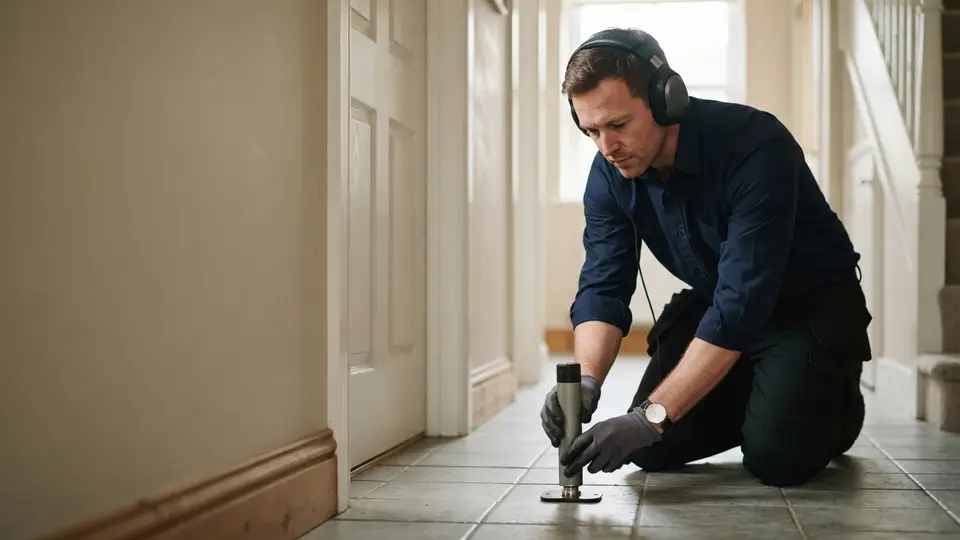
Pressure drop test
What it reveals: Whether the system is losing water
Where we use it: Start of every call

Ceiling stain spreading, or a pipe that split overnight at ten below? We handle leak detection and repair in New Hampshire. Our plumbers locate hidden leaks in walls, ceilings, basements, crawl spaces and yards and repair them, including pipes that burst or freeze in hard winters. New Hampshire homes leak where cold reaches pipes in old farmhouse ells and exterior walls, where century-old galvanized has rusted thin, where boiler piping weeps and where a lake house loses heat while empty. We pinpoint the leak before opening anything and give you a written price for the fix.
The service
With 38% of homes built before 1960, many New Hampshire houses still have galvanized steel, early copper or a patchwork of both, with supply lines running through plaster walls and fieldstone basements. In Berlin, 89% of homes predate 1980, and in Claremont 82%. Homes on wells add another clue: when there is a leak, the well pump runs even when nobody is using water.
How we track down leaks
What it reveals: Whether the system is losing water
Where we use it: Start of every call
What it reveals: Water escaping behind surfaces
Where we use it: Floors, walls and yard lines
What it reveals: Cold or damp patches
Where we use it: Ceilings, walls, heating lines
What it reveals: Wet plaster, wood and insulation
Where we use it: Measuring the spread
What it reveals: A well pump running with taps off
Where we use it: Homes on private wells
Why New Hampshire
Pipes in ells, exterior walls and crawl spaces split when temperatures drop far below zero.
Steel pipe a century old corrodes from inside and fails at the threads.
Some New Hampshire wells have low pH water that pits copper over time.
Freezing ground shifts the water line from the well or street.
Warning signs
Our process
We pressure test, isolate branches and use listening, infrared and moisture tools to find the leak before cutting plaster or drywall.
We open the smallest area we can, replace the failed section in copper or PEX and test before closing up.
With the water off, we replace split pipe and check every run that froze in the same cold.
We thaw lines gently, watch for splits as water returns and reroute or insulate pipe that freezes year after year.
Typical cost
Before we test, any figure is an estimate only. The final price depends on:
We give you a written price for the repair before we start.
Get a written price: (833) 733-2357Plaster, floors and yards take more locating.
Plaster walls and finished ceilings take care to open and patch.
Rusted galvanized or pinholed copper may need more replaced.
One freeze can split pipe in several places.
After-hours visits cost more.
Benefits
We open only where the leak is.
A well pump stops running for a hidden leak.
Early repair limits rot in framing and sills.
Notes and photos for your claim.
Many New Hampshire homes grew over generations: a main house, an ell, a connector and a barn, built at different times with different insulation. Kitchens and baths were often added in the ell, with pipes running through cold floors or along outside walls. Those pipes freeze first. We trace where cold air reaches the pipes, then insulate, add heat cable or reroute lines inside the heated part of the house.
Water from some New Hampshire wells, especially shallow dug wells and some bedrock wells, is slightly acidic. Over years it eats copper from the inside, leaving blue-green stains in sinks and tiny pinhole leaks in pipe. Repairing one pinhole often leads to another. We test the water, repair the leak and recommend a neutralizing filter so the remaining copper lasts, or a repipe in PEX if pinholes are widespread.
Buildings with five or more units hold 33% of homes in Manchester and 32% in Dover. In stacked apartments, a leak in one unit shows up in the ceiling below. We trace it to the source, whether a supply line, drain, tub overflow or heating pipe, and coordinate access with landlords and tenants.
33% of homes in Meredith and 35% in North Conway are vacant on a typical day. If a furnace fails in an empty house in January, pipes freeze, then burst during the next thaw, and water can run for days. We repair the damage, check the whole system and fit low-temperature alarms and automatic shutoff valves that close the main when they sense water.
Close the main shutoff, usually in the basement where the line enters, or switch off the well pump breaker. Turn off the water heater or boiler if the leak is on a hot line, and cut power near wet areas.
Move belongings and take photos. If a pipe is frozen but intact, open the faucet and warm the area gently with a hair dryer, never an open flame. Then call us.
Small leak repairs usually do not need a permit; repiping or service line replacement may, depending on your town, and we pull it. Our plumbers hold the New Hampshire licenses each job requires. Many policies cover sudden water damage but may exclude homes left unheated; we document the cause for your claim.
Why choose us
What you can count on every time one of our plumbers comes to your door.
Every job is handled by a plumber who holds the license your state or city requires, backed by liability insurance.
Our plumber explains the problem and the options, and you approve a written price before any work begins.
Burst pipes, sewage backups and failed water heaters get priority scheduling, including nights and weekends.
We pull permits when the job needs one and schedule the inspection, so the work holds up when you sell.
Repairs and installations come with a written warranty on labor, on top of the manufacturer's warranty on parts.
Our pages and plumbers account for your area's water, soil, climate and the age of the homes around you.
Service area
We find and fix leaks in 100 New Hampshire communities, including Manchester (52,108 homes) and Keene (10,540 homes). Find yours:
It depends on how hidden the leak is and which tools it takes. We price detection before starting and give you a written price for the repair.
One leak in sound pipe is cheaper to repair. If galvanized or pinholed copper keeps failing, repiping usually costs less over a few years.
Many policies cover sudden damage but may exclude homes left without heat. Check your policy; we provide notes and photos for the claim.
We pressure test, isolate lines and use listening, infrared and moisture tools, so we open only a small, precise area of the wall.
We check the meter or well pump and run a pressure test, then isolate hot, cold and heating lines to narrow the search.
Yes. A boiler that keeps needing water usually has a leak in its piping or radiators. We find and repair it.
Usually, if water is off and wet areas are away from electricity. Watch for sagging plaster ceilings and keep away from them.
Yes. Mould grows on damp plaster and wood within days, and long leaks rot sills and joists. Fix and dry leaks promptly.
Most leaks are found within an hour or two. Long service lines from wells or leaks under floors can take longer.
Most single breaks are repaired in a few hours. Several breaks from one cold night can take longer.
Insulate pipes in ells and crawl spaces, open cabinets on outside walls, let faucets drip in deep cold and keep heat steady.
Yes. An alarm that texts you when the temperature drops gives you time to act before pipes freeze.
Close the main or switch off the well pump, turn off the water heater, keep away from wet outlets and call us.
Acidic well water often causes them. We test pH, fix the leak and recommend a neutralizer or repipe.
It usually means a leak somewhere in the system, or a failing pressure tank. We test to find which.