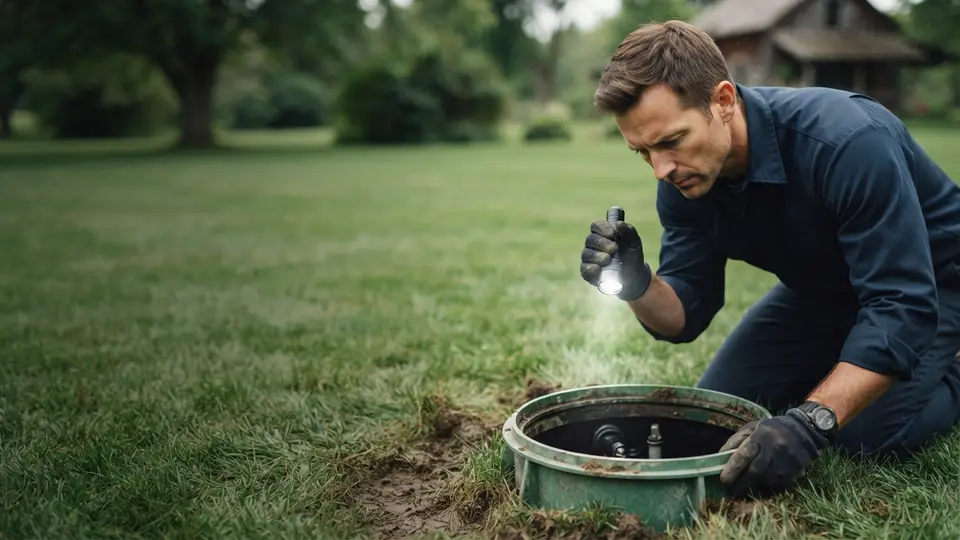
Gravity tank and leach field
Where it fits: Well-drained soil
What it needs: Pumping and field checks

Drains slowing all at once, or a wet patch over the leach field? We handle septic tank services in New Hampshire. Our plumbers pump tanks, inspect systems for home sales and repair or replace leach fields across southern New Hampshire towns, the Lakes Region, the Monadnock hills and the White Mountains. New Hampshire systems deal with rocky soil and ledge, high water tables in spring, frost that reaches deep into the ground and lakefront lots where every gallon of effluent matters. We find out why the system is struggling and give you a written price.
The service
A septic system holds household waste in a buried tank, where solids settle and scum floats. Clearer effluent flows to a leach field, where the soil filters it before it reaches groundwater. On thin or wet soils, New Hampshire systems often use raised beds, pumped systems or engineered chamber designs.
Outside the sewered cities, septic is the norm. Towns such as Epping (median build year 1990), Raymond, Londonderry and much of Rockingham and Strafford counties are largely on septic, as is nearly every home in the Lakes Region and North Country.
Septic systems we service
Where it fits: Well-drained soil
What it needs: Pumping and field checks
Where it fits: Field uphill or far from the house
What it needs: Pump, floats and alarm service
Where it fits: Ledge, shallow soil, high water table
What it needs: Pump and surface checks
Where it fits: Lakefront or tight lots
What it needs: Regular maintenance
Why New Hampshire
Bedrock near the surface leaves little soil to treat effluent.
Snowmelt and mud season raise groundwater into leach fields.
Thin snow, compacted soil or an empty house can let frost reach pipes and tanks.
Many fields were built decades ago for smaller households.
Warning signs
Our process
We uncover the covers, pump the tank, check the inlet and outlet baffles and effluent filter and note sludge and scum levels for your records.
For a sale or a problem system, we inspect the tank, pump and alarm if present, distribution and leach field, and write up our findings.
We repair broken or frozen lines and distribution boxes. When a field has failed, a new design is prepared and approved under state rules before we build it.
Typical cost
Any figure before we see the system is an estimate only. Price depends on:
You get a written price, and nothing starts until you approve it.
Get a written price: (833) 733-2357Deep or snow-covered covers take time.
Pumped systems and raised beds have more parts.
Rock and wet ground complicate field work.
Repairing lines costs far less than a new field.
Frozen ground can delay excavation.
Benefits
Pumping keeps solids out of the leach field.
A working system protects groundwater.
Inspections find weak spots before cold arrives.
Records and an inspection report reassure buyers.
33% of homes in Meredith, 32% in Wolfeboro and 30% in Laconia are vacant on a typical day, many of them summer homes on Lake Winnipesaukee and smaller lakes. Old camp systems were often built close to the water, and shoreland rules now limit what can be done near lakes. Heavy summer use then strains small tanks. We pump before and after the season, check for systems that need upgrading and work with designers when a replacement must meet shoreland requirements.
In Conway, propane heats 42% of homes, and 35% of homes in North Conway are vacant on a typical day, largely ski condos and vacation houses. Mountain lots have shallow soil and ledge, and winters are long. Septic lines in empty homes, with no warm water flowing, are prone to freezing. We pump, thaw and repair systems and plan larger work for the snow-free months.
Derry (9,904 homes), Londonderry, Raymond and the towns along Route 101 grew quickly from the 1970s on, and many of those homes are on their original septic systems. Families are larger, laundry loads heavier and some fields are reaching the end of their life. We pump and inspect them and, when a field fails, explain repair or replacement options under state rules.
Most New Hampshire homes on septic also drink from a private well on the same lot, often a bedrock well drilled through granite. Cracks in the rock can carry contaminants farther than people expect, so a working septic system and proper separation from the well both matter. In towns such as Peterborough (1,613 homes), Raymond and Epping, we check that tanks and fields are working, note how far they sit from the well and recommend testing the well for bacteria if a field has failed. When a replacement is designed, well location is part of the plan.
Cut water use: delay laundry, run the dishwasher later and take short showers. If a pump alarm is sounding, silence it but leave the pump circuit on.
Keep vehicles and snowmobiles off the tank and field, and keep people and pets away from wet or sewage-covered ground. Never open or enter a septic tank yourself. Then call us.
New septic systems and many repairs in New Hampshire need a design approved by the Department of Environmental Services, prepared by a permitted designer and built by a permitted installer, with town sign-off where required. We handle pumping, inspection and repair, and coordinate the approval process for larger work. Our plumbers hold the licenses each job requires.
Why choose us
What you can count on every time one of our plumbers comes to your door.
Every job is handled by a plumber who holds the license your state or city requires, backed by liability insurance.
Our plumber explains the problem and the options, and you approve a written price before any work begins.
Burst pipes, sewage backups and failed water heaters get priority scheduling, including nights and weekends.
We pull permits when the job needs one and schedule the inspection, so the work holds up when you sell.
Repairs and installations come with a written warranty on labor, on top of the manufacturer's warranty on parts.
Our pages and plumbers account for your area's water, soil, climate and the age of the homes around you.
Service area
We service septic systems around 100 New Hampshire communities, including Rochester (14,698 homes) and Plymouth (1,371 homes). Find yours:
It depends on tank size, how deep the covers are and travel. We give you a written price before we start.
Usually. If only a few lines or the distribution box failed, repair costs much less than a new field.
Yes. A full inspection report for a home sale covers the tank, pump, distribution and leach field.
We uncover and pump the tank, check baffles, filter, pump and alarm, look at distribution and walk the field for wet spots.
Yes. We trace the line from the house with a locator and probe for the covers.
A replacement is designed and approved under state rules, then built. We explain the process, timing and costs.
No. Septic gases are dangerous and old covers can collapse. Leave it to us.
Yes. Effluent can reach groundwater or nearby water. Fix failing systems quickly and test your well.
About an hour once covers are exposed. Snow and deep covers add time.
Design and approval can take weeks. Building often takes a few days, and frozen ground can push it to spring.
Every two to four years for most homes, more often for large households or busy rentals.
Leave snow cover in place, keep vehicles off the field, fix running fixtures and keep warm water flowing if the home is used.
Keep people and pets away, cut water use and call us. It is a health hazard.
Yes. Shoreland rules limit work near lakes, and replacements must meet them. We coordinate with designers.
If it sees heavy summer use, often yes, or at least inspect it each season.