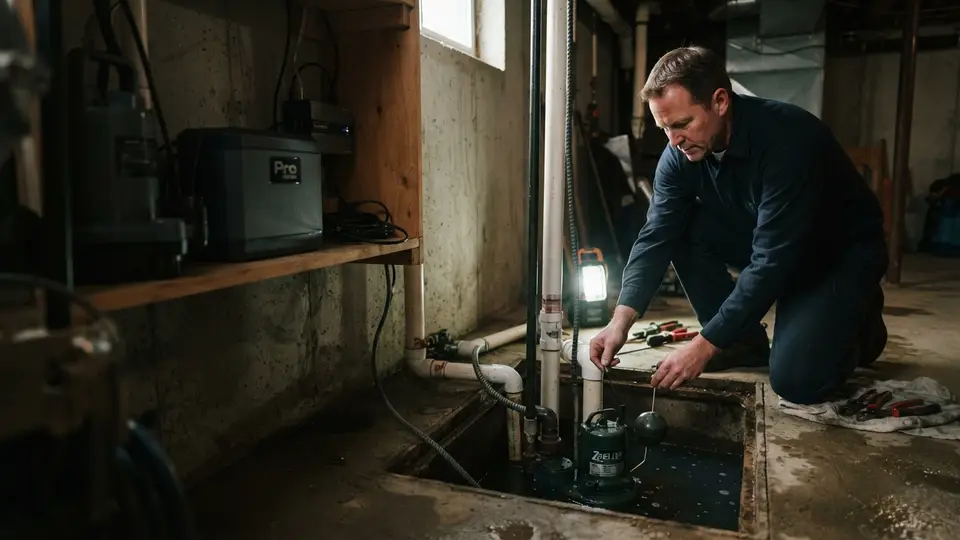
Primary pump
What it does: Removes water from the pit
What we check: Motor, impeller, float, cord
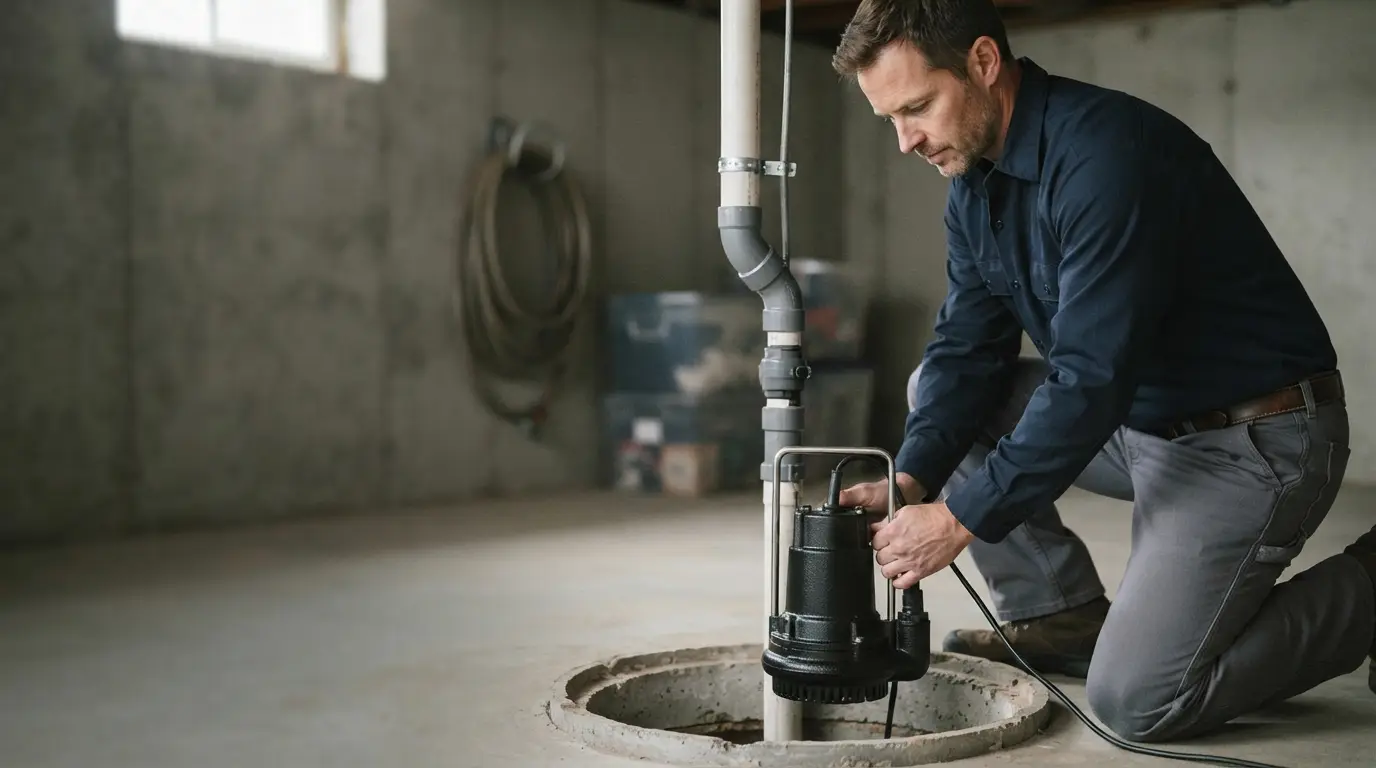
Water seeping into the basement after a storm, or a crawl space that never dries? We do sump pump repair and installation in Georgia homes. Metro Atlanta and North Georgia have many basements built into hillsides, where groundwater flows downhill against the walls. Elsewhere, crawl spaces in red clay hold water after heavy rain, and low coastal lots sit near the water table. A working sump pump keeps that water away from framing, ductwork and stored belongings. We repair, replace and install pumps and add backups.
The service
A sump pump sits in a pit at the lowest point of a basement or crawl space. Water reaches the pit through drain pipe around the foundation or across the crawl space floor. When it rises, a float switch starts the pump, which pushes water through a discharge line away from the house. A check valve stops it flowing back. In Georgia, sump systems are most common in hillside basements and wet crawl spaces.
Sump equipment we service
What it does: Removes water from the pit
What we check: Motor, impeller, float, cord
What it does: Stops pumped water returning
What we check: Seal, direction, noise
What it does: Carries water away
What we check: Breaks, clogs, outlet location
What it does: Pumps during outages
What we check: Battery, charger, alarm
What it does: Collects groundwater
What we check: Silt, red clay, flow
Why Georgia
Rolling terrain around Atlanta means many homes have basements dug into slopes, where groundwater moves downhill against the uphill wall. Suburbs like Dunwoody (median home built 1984), Roswell and Marietta have many such homes.
Clay absorbs water slowly, so rain runs along the surface toward the house and collects under it. Clay silt also clogs pits and drain pipe.
Spring storms and tropical systems can drop several inches of rain in a day, overwhelming drainage around foundations.
In Savannah and Brunswick, where 72% of homes predate 1980, groundwater sits close to the surface and storm tides raise it further.
Warning signs
Our process
We test the float, motor and impeller, clear clay silt from the pit, replace failed check valves and inspect the discharge. Burned-out pumps are replaced with units sized to the inflow.
For a new system, we set a lined pit at the low point, connect perimeter or crawl space drains, install the pump and check valve and route the discharge well away from the foundation.
Thunderstorms and ice storms cut power. A battery backup takes over when the main pump stops and sounds an alarm. We install it with a charger and show you how to test it.
Typical cost
We give a written price before work begins.
Get a written price: (833) 733-2357A float or check valve costs less than a pump.
Cutting a basement floor or trenching a crawl space adds labor.
High-flow pumps cost more.
Batteries and alarms add equipment.
Long or buried lines add materials.
Low crawl spaces take longer.
Benefits
Finished spaces and storage stay dry.
Dry crawl spaces prevent rot.
Less moisture means less mold.
Furnaces and water heaters stay out of water.
Standing water in a crawl space rots framing, ruins insulation and ductwork, and feeds mold in Georgia's humid climate. A sump pit at the low point, fed by drain pipe across the floor and combined with a vapor barrier, keeps the space dry. Outside, extending downspouts and regrading soil away from the foundation reduces the water reaching it. We install the pump and drains and recommend the outside fixes that make the system work less.
Finished basements in metro Atlanta often hold family rooms, offices and guest suites. A single pump failure during a storm can ruin carpet and drywall. A backup pump, a high-water alarm and a pump replaced before it wears out are inexpensive compared with a basement restoration.
Basement bathrooms below the sewer line need an ejector pump to lift wastewater to the main. When it fails, basement fixtures back up. We repair and replace ejector pumps, sealed basins, check valves and alarms.
An open sump pit lets moisture and soil gases into the basement. A sealed, gasketed cover keeps them out while the pump works normally, and it works alongside a radon mitigation system if you have one. We install sealed covers during sump service.
For homes with standby generators, we make sure the sump pump is on a generator circuit, coordinating with your electrician.
Battery backups suit most homes. Homes on public water with good pressure can use a water-powered backup that needs no battery; it is not suitable for homes on wells. We help you choose based on how long your pump must run during a storm and how often your power goes out.
A simple high-water alarm in the pit warns you before water reaches the floor, giving time to act if the pump fails.
Check the pump is plugged in and the breaker or GFCI has not tripped. If the float is stuck, unplug the pump and free it.
Do not walk through standing water where cords or equipment may be submerged. Shut off power to the area from a dry spot if you can, and call us.
Replacing a pump in an existing pit usually needs no permit. New pits, drains and discharge connections may, and sump discharge into the sanitary sewer is generally not allowed. Our plumbers hold the Georgia licenses required, and we check local rules first.
Why choose us
What you can count on every time one of our plumbers comes to your door.
Every job is handled by a plumber who holds the license your state or city requires, backed by liability insurance.
Our plumber explains the problem and the options, and you approve a written price before any work begins.
Burst pipes, sewage backups and failed water heaters get priority scheduling, including nights and weekends.
We pull permits when the job needs one and schedule the inspection, so the work holds up when you sell.
Repairs and installations come with a written warranty on labor, on top of the manufacturer's warranty on parts.
Our pages and plumbers account for your area's water, soil, climate and the age of the homes around you.
Service area
We repair and install sump pumps in 675 Georgia places, from Atlanta (265,899 homes) and Roswell to Savannah. Choose yours:
Many repairs, such as a float or check valve, are modest. A burned-out motor means a new pump. You get a written price before we start any work.
It depends on whether a pit and drains exist, pump size, the discharge route and access. We price it after seeing the space.
Yes for most basements. Storms that bring water often bring outages too, and a backup keeps pumping when power fails.
Often, combined with drains, a vapor barrier and better outside drainage. We look at the cause first.
We measure how fast the pit fills and how far and high water must go, then choose a pump with enough capacity.
To the yard, well away from the foundation, where it drains away. Not into the sanitary sewer.
Not if electrical equipment or cords may be in the water. Shut off power from a dry spot and wait for us.
Ground-fault protection is commonly required. We check the connection and recommend what your location needs.
Usually one to two hours in an existing pit. A new pit with drains can take a day or more.
Right away. Water above the rim reaches finished floors and equipment quickly.
Before spring storms and after long dry spells. Fill the pit with water and watch it start and stop.
Often seven to ten years. Pumps that run often or handle clay silt wear out sooner.
Check pump power, keep away from water near electrical equipment and call us. Flooding gets priority scheduling.
Fine clay particles wash in with groundwater and settle in the pit and drains. Yearly cleaning keeps the pump working.
Groundwater moves downhill through the soil and presses against the uphill basement wall, especially after heavy rain.