Crust on fixtures, spotted dishes
Usual cause: Hard water from limestone
Treatment: Softener
White crust on the shower glass, or well water that smells of sulfur? We install water softeners and filtration in Georgia after testing your water. Georgia water splits roughly north and south. Metro Atlanta and North Georgia mostly drink soft river and reservoir water, while South and coastal Georgia draw harder water from the limestone Floridan aquifer, and many private wells carry sulfur, iron or acidity. We test, explain what we find and install a softener, sulfur or iron filter, carbon system or reverse osmosis to fit.
The service
Every piece of equipment targets one problem. A softener pulls out hardness. An oxidizing filter strips sulfur and iron. A neutralizer raises the pH of acidic well water. Carbon removes chlorine or chloramine taste. Reverse osmosis at one tap makes highly filtered drinking water. Most homes need one or two of these, and our test tells us which.
What we find and how we treat it
Usual cause: Hard water from limestone
Treatment: Softener
Usual cause: Hydrogen sulfide in a well
Treatment: Oxidizing filter or aeration
Usual cause: Iron
Treatment: Iron filter
Usual cause: Acidic well water
Treatment: Neutralizer
Usual cause: Disinfection
Treatment: Carbon filter
Usual cause: Dissolved minerals
Treatment: Reverse osmosis at the kitchen sink
Why Georgia
Atlanta, with 265,899 homes in our data, and most of North Georgia drink treated river and reservoir water that is usually soft. Few homes there need a softener, though some want a carbon filter for taste.
Savannah, Valdosta, Albany and Brunswick draw from the Floridan aquifer, which runs through limestone. That water is often hard, and scale builds quickly in heaters and fixtures.
Private wells in South and coastal Georgia often carry hydrogen sulfide, the rotten-egg smell, and some carry iron that stains fixtures and laundry.
Some wells in the granite and clay of the Piedmont produce low-pH water that slowly dissolves copper, leaving blue-green stains and pinhole leaks.
Warning signs
Our process
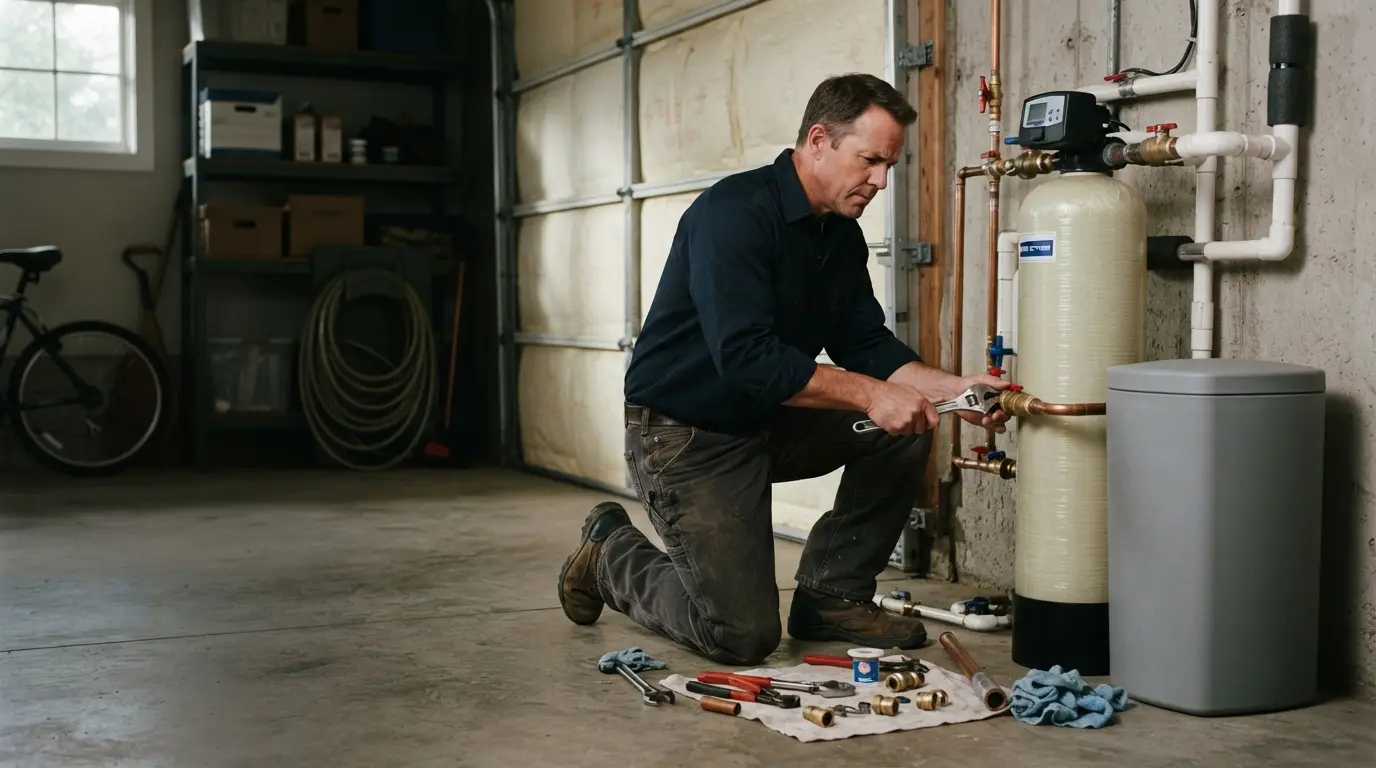
We test hardness and iron, size the softener to your household and fit it at the main line with a bypass, an air-gapped drain and a nearby outlet. Hose bibs and irrigation can stay on untreated water.
We install sulfur, iron, neutralizing, sediment or carbon systems where water enters the house, in an order that lets each stage work.
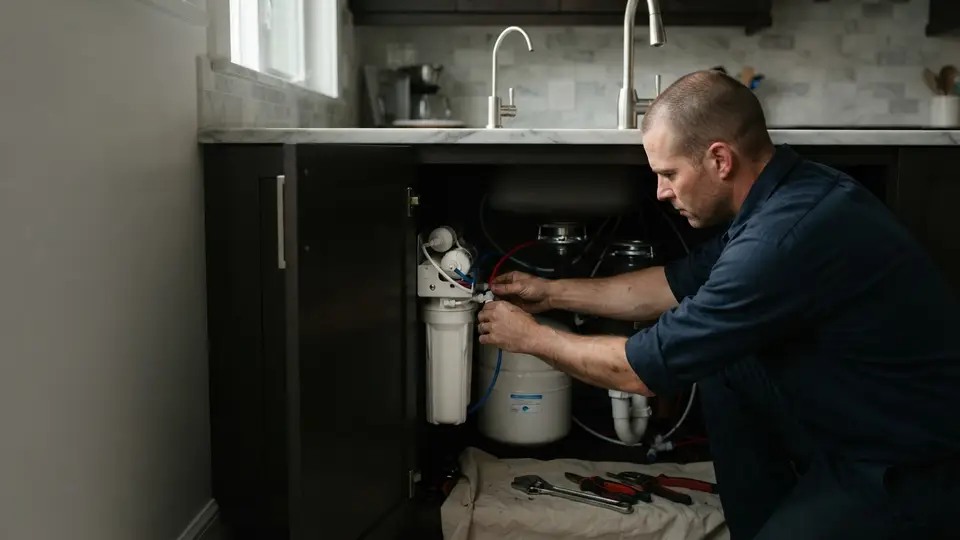
We mount the unit under the kitchen sink with its own faucet and set a filter and membrane schedule.
Typical cost
You get a written price and a maintenance plan before we install.
Get a written price: (833) 733-2357Sulfur, iron and pH correction cost more than softening alone.
Some wells need two or three systems.
Bigger households need more capacity.
Garages and utility rooms near the main are simplest.
Salt, media and filters are ongoing costs.
Benefits
Less scale on elements and in tanks.
Sulfur filters remove the odor.
Iron filters keep fixtures and laundry clean.
Neutralizers stop acidic water eating pipe.
Our data includes 138 unincorporated Georgia communities, many with homes on private wells, and wells are common around towns like Waycross, where 9% of homes are manufactured homes. Well owners are responsible for their own water quality. We test for treatment basics and recommend a certified lab test for bacteria and other contaminants; your county health department can point you to testing.
If only the hot water smells, the cause is often a reaction between the water and the magnesium anode rod in the heater rather than sulfur throughout the well. A different anode, and sometimes sanitizing the tank, usually fixes it without whole-house treatment. We test hot and cold separately to tell the difference.
In South Georgia, hard water coats electric heating elements and fills tanks with scale, cutting capacity and shortening life. Softening the water, or at least flushing the heater every year, protects it. Tankless heaters need regular descaling where water is hard.
Renters occupy 45% of Georgia homes in our data. Where a whole-house system is not possible, a reverse osmosis unit or carbon filter at the kitchen sink improves drinking water. Renters should check with the owner first.
A softener removes hardness minerals, so spots disappear and soap lathers easily, but it uses salt and sends brine to the drain or septic system. A salt-free conditioner reduces scale on heaters and pipes without salt but leaves the minerals in the water. If protecting the heater and plumbing is the main goal, a conditioner may be enough; for the full soft-water feel, a softener is the better choice. We explain both after testing.
Softeners and backwashing filters send water, and for softeners salt, to the drain during regeneration. In septic homes, efficient units and correct settings keep that extra load small, which matters when clay soil is already slow to drain.
Shallow wells in low, wooded parts of South Georgia can draw water tinted yellow or brown by tannins from decaying vegetation. It stains laundry and fixtures. A tannin removal system clears the color; we test for tannins separately from iron, since they look alike but need different treatment.
Equipment in homes left empty for weeks needs attention on return: we flush filters, break up salt bridges and reset systems.
If you have a recent well test or your provider's water quality report, keep it ready. Note whether smells or stains show up in hot water, cold water or both, and clear access to the main line or well tank.
If equipment is leaking, put it in bypass, unplug it and call us. Do not pour chemicals into your well.
Many treatment installs need no permit, though some jurisdictions require one for new connections. Our plumbers hold the Georgia licenses required, and every drain connection includes an approved air gap.
Why choose us
What you can count on every time one of our plumbers comes to your door.
Every job is handled by a plumber who holds the license your state or city requires, backed by liability insurance.
Our plumber explains the problem and the options, and you approve a written price before any work begins.
Burst pipes, sewage backups and failed water heaters get priority scheduling, including nights and weekends.
We pull permits when the job needs one and schedule the inspection, so the work holds up when you sell.
Repairs and installations come with a written warranty on labor, on top of the manufacturer's warranty on parts.
Our pages and plumbers account for your area's water, soil, climate and the age of the homes around you.
Service area
We test and treat water in 675 Georgia places, from Savannah (68,174 homes) and Valdosta to Albany and Brunswick. Choose yours:
It depends on hardness, household size and where it goes, plus any other treatment your water needs. We test first and give you a written price.
Often, yes. Sulfur needs oxidizing media or aeration, and strong sulfur may need its own system ahead of a softener.
Mainly filter and membrane changes on a set schedule, which we explain when we install it.
Yes. We test at your tap and review any provider report or well test before recommending equipment.
Usually not. Most metro Atlanta water is soft; some homes add a carbon filter for taste.
Yes. We route the system so irrigation and hose bibs stay on untreated water, saving salt.
For most people, yes. It adds a little sodium; a reverse osmosis tap gives low-sodium drinking water.
Treatment tests do not cover bacteria and other contaminants. Have a certified lab test your well.
Most single systems take a few hours; multi-stage well systems can take most of a day.
Treated water is immediate. Old scale and stains need cleaning once, then stop coming back.
Often every month or two, depending on hardness and use.
Every year or two, and whenever taste, smell or color changes.
Put it in bypass, unplug it and call us. A stuck valve or drain line is the usual cause.
It comes from the limestone Floridan aquifer, which adds calcium and magnesium to the water.
Usually acidic well water dissolving the copper. A neutralizer stops it and protects the pipe.