Salt-based softener
What it does: Removes hardness minerals by ion exchange
Best for: Most Arizona homes with hard water
White crust on faucets and spotty glasses? Water Softeners & Filtration in Arizona from our plumbers deal with the hard water behind it. Nearly every part of the state has hard water, whether it comes from the Colorado River, the Salt and Verde rivers or local wells. The minerals build scale in water heaters, fixtures, pipes and appliances and shorten their lives. This page explains how softening and filtration work, which system fits which home, how we install and maintain them and what affects the price.
The service
Hard water carries dissolved calcium and magnesium. A conventional softener passes water through a tank of resin beads that trade those minerals for sodium or potassium. When the resin is full, the system flushes it with brine from a salt tank and starts over. The water that comes out leaves little or no scale on fixtures, in pipes or inside the water heater.
Our work in this service covers water softener installation, whole-house filtration, reverse osmosis. Softening and filtration solve different problems, so we test your water first and recommend what it actually needs.
Water treatment options
What it does: Removes hardness minerals by ion exchange
Best for: Most Arizona homes with hard water
What it does: Changes minerals so they scale less; does not remove them
Best for: Homes that cannot use salt discharge
What it does: Reduces chlorine, sediment, taste and odor
Best for: City water taste and smell
What it does: Removes most dissolved solids for drinking water
Best for: Drinking and cooking water
Why Arizona
Colorado River water carried by the Central Arizona Project, Salt and Verde river water and groundwater from aquifers all pick up minerals as they travel through Arizona's rock and soil. Hardness varies by provider and by season, so the reading at your tap is what counts.
Scale forms faster in hot water. Water heaters, tankless heat exchangers and dishwashers take the worst of it, and Arizona's warm incoming water in summer does not help.
Some Arizona supplies, especially well water and blended river water, carry high levels of total dissolved solids that affect taste even after softening. Reverse osmosis at the kitchen sink handles that.
Our Arizona Census data covers 2,979,835 homes, from apartments to large single-family houses. 64% are detached houses, where a whole-house softener in the garage is the usual setup; condos and apartments often need a smaller unit or point-of-use filtration.
Warning signs
Our process
We test hardness, and where useful iron, chlorine and dissolved solids, at your tap. That tells us whether you need softening, filtration or both, and how large the system should be.
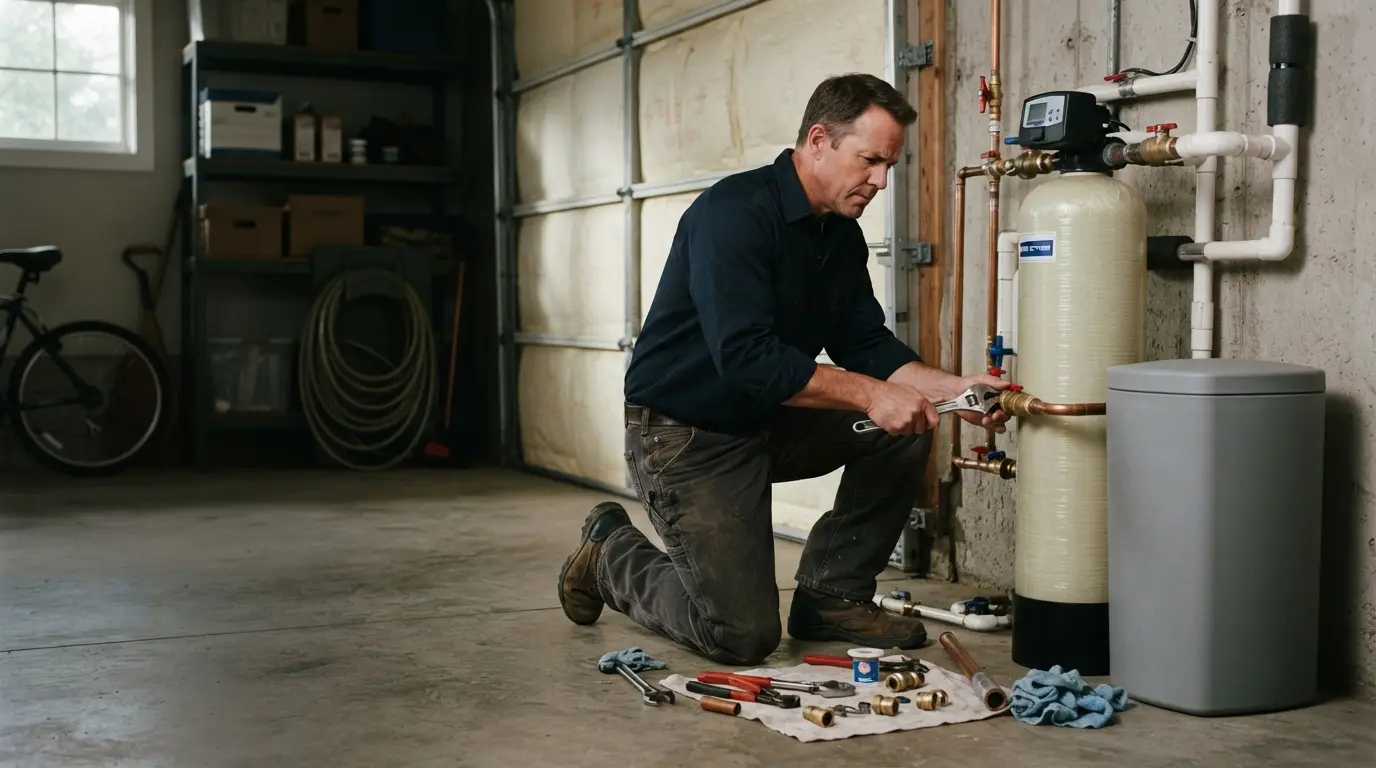
We size the softener to your hardness and household water use, install it on the main line with a bypass valve, connect the drain line with an air gap and set the regeneration schedule. Most Arizona homes have a softener loop in the garage; if yours does not, we add the piping.
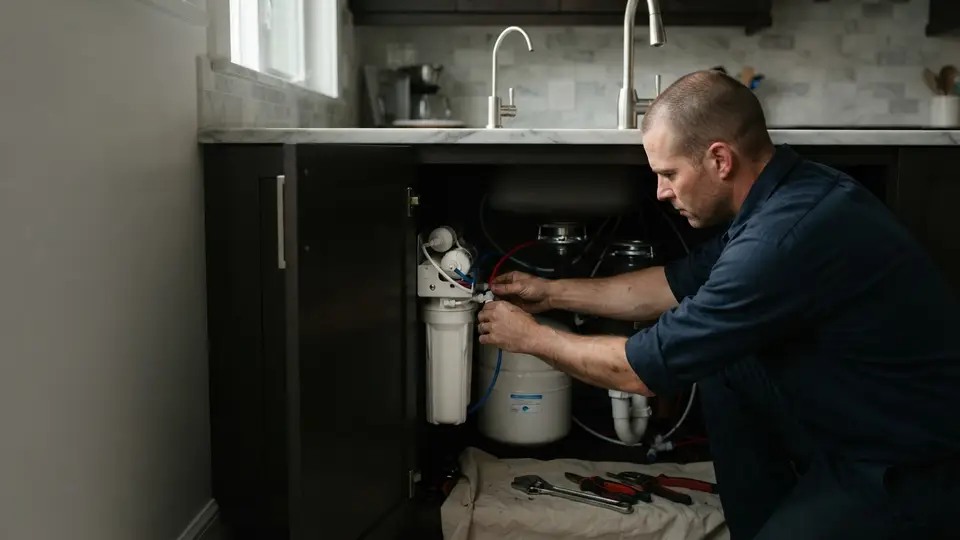
We install whole-house carbon or sediment filters and under-sink reverse osmosis units, with a dedicated faucet and connections to refrigerators if you want them.
We fix control valves, timers, injectors, brine lines and salt bridges, and replace resin when it is worn out. If a system is too old or too small, we tell you.
Typical cost
After testing your water, we give you a written price for the system that fits, with no extras you do not need.
Get a written price: (833) 733-2357Larger households and harder water need more capacity.
A garage softener loop makes installation simpler; adding one takes more piping.
Carbon filters and reverse osmosis add equipment.
Distance to a suitable drain affects the work.
A valve repair costs less than a new system.
Benefits
Less sediment means less overheating and fewer early failures.
Far less crust on faucets, shower glass and tile.
Cartridges, fill valves and aerators last longer.
Soap and detergent work with less product.
If your softener is leaking, put it in bypass mode using the bypass valve on the back of the control head; water will still reach the house, unsoftened. If the brine tank is overflowing, unplug the unit.
If the salt level never drops, check for a hard salt crust (a bridge) across the tank. You can break it up gently with a broom handle. If water still is not softening, call us and we will find the fault.
Softening deals with minerals. Filtration deals with what else is in the water. On city water, a whole-house carbon filter reduces the chlorine or chloramine taste and smell at every tap and shower. On well water, which many rural Arizona homes rely on, a sediment filter catches sand and grit before it reaches fixtures, and further treatment may be needed depending on what a lab test of the well shows.
We place filters ahead of the softener so the resin lasts longer, add shutoff and bypass valves so cartridges are easy to change, and leave you a simple schedule for replacing them.
Salt-based softeners send brine down the drain during regeneration. Some Arizona communities and some septic systems have rules or concerns about that discharge, and efficient, demand-based regeneration reduces it. Where salt discharge is a concern, we can suggest a salt-free conditioner or a high-efficiency softener. Confirm local rules with your city or county; we check them during the estimate.
Installing a softener on an existing loop may not need a permit; adding new piping or a drain connection can. Our Arizona work is done under a plumbing contractor license from the Arizona Registrar of Contractors, and we pull permits when the job needs one.
Why choose us
What you can count on every time one of our plumbers comes to your door.
Every job is handled by a plumber who holds the license your state or city requires, backed by liability insurance.
Our plumber explains the problem and the options, and you approve a written price before any work begins.
Burst pipes, sewage backups and failed water heaters get priority scheduling, including nights and weekends.
We pull permits when the job needs one and schedule the inspection, so the work holds up when you sell.
Repairs and installations come with a written warranty on labor, on top of the manufacturer's warranty on parts.
Our pages and plumbers account for your area's water, soil, climate and the age of the homes around you.
Service area
Hardness differs from one water provider to the next. Choose your city:
It depends on the system type, capacity and whether your home has a softener loop. After testing your water, you get a written price.
For drinking water in areas with high dissolved solids, many owners find it worthwhile. It improves taste and reduces many dissolved contaminants.
Usually, if the tank and resin are in good shape. Older systems with worn resin and valves are often better replaced.
Yes. We test hardness and, where useful, iron, chlorine and dissolved solids before recommending a system.
Piping in many Arizona garages that lets a softener connect to the main line. If you do not have one, we can add it.
A softener removes hardness minerals. A salt-free conditioner changes them so they scale less but leaves them in the water.
For most people, yes. It adds a small amount of sodium. People on low-sodium diets can use potassium or drink reverse osmosis water.
Often yes, with an efficient model. Brine discharge can affect some systems, so we look at your septic setup before recommending one.
On an existing loop, usually a few hours. Adding a loop or reverse osmosis can take most of a day.
Many last 10 to 15 years with care. Resin may need replacing sooner with very hard water or chlorine.
Check monthly and keep the tank at least a third full. Use depends on hardness and water use.
Every year or two, and whenever water starts feeling hard again or the salt level stops dropping.
Put it in bypass and unplug it, then call us. A leaking control valve or stuck float is usually the cause.
River and groundwater sources pick up calcium and magnesium as they pass through mineral-rich rock and soil.
Some communities and septic systems have concerns about brine discharge. We check local rules during the estimate.