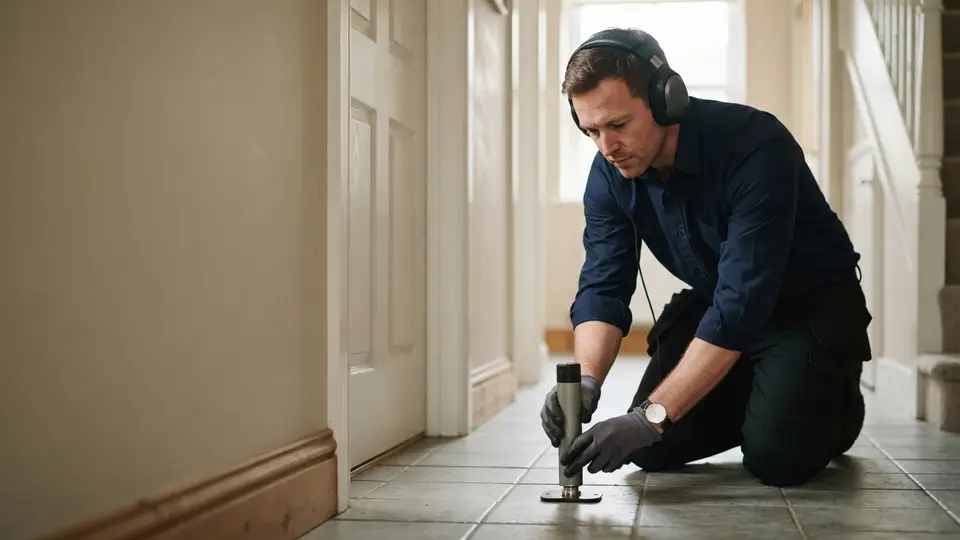
Acoustic listening
What it finds: The sound of water escaping
Best for: Pressurized supply lines

Stain spreading on the ceiling, or a pipe split by frost? We handle leak detection and repair in Massachusetts. Our plumbers locate hidden leaks with acoustic, thermal and pressure tools, then repair the pipe with as little opening of walls as we can manage. Old plaster walls, multifamily buildings and long winters make leaks here hard to find and quick to spread. We also thaw frozen lines and repair pipes that burst in a cold snap.
The service
Leaks in older homes rarely show up where they start. Water runs along joists, behind plaster and down through floors before it stains a ceiling. With 53% of Massachusetts homes built before 1960, many leaks come from galvanized pipe, old soldered joints or worn valves hidden in walls that were plastered decades ago. In multifamily buildings, a leak on one floor shows up in the unit below.
Tools our plumbers use to find leaks
What it finds: The sound of water escaping
Best for: Pressurized supply lines
What it finds: Temperature changes from water
Best for: Hot lines, radiant heat, walls
What it finds: Whether a section holds pressure
Best for: Isolating supply branches
What it finds: Wet framing and plaster
Best for: Tracing the spread of water
What it finds: Inside walls and ceilings
Best for: Seeing pipe through small holes
Why Massachusetts
Pipes in exterior walls, porches and unheated basements freeze and split during January cold.
Galvanized supply rusts from the inside out and starts leaking at threaded joints.
Decades-old shutoffs, unions and solder joints give out under normal pressure.
Low-mineral or acidic water from some wells and supplies can thin copper pipe over time.
Warning signs
Our process
We start at the meter to confirm a leak, isolate branches with pressure tests and then pinpoint the spot with acoustic and thermal tools before cutting into anything.
We open a small access, replace the failed pipe or fitting with copper or PEX and pressure test the repair before closing up.
We shut off and drain the line, cut out the split section and replace it, then check nearby pipe that may have been weakened by the same freeze.
We find the frozen section, thaw it with controlled heat, check for cracks and recommend insulation, heat or rerouting so it does not freeze again.
Typical cost
Leak repair prices are estimates only until we find the leak. These factors set the cost:
You get a written price before we open walls or start the repair.
Get a written price: (833) 733-2357Hidden leaks take more testing time.
Inside plaster walls, ceilings or under a slab.
Galvanized often needs more than a patch.
Several splits mean more repairs.
Finished spaces and multifamily units.
After-hours visits cost more.
Benefits
We cut where the leak is, not everywhere.
Hidden leaks stop wasting water.
Wet framing gets found and dried sooner.
Documentation helps with insurers and condo boards.
Pittsfield, where 85% of homes predate 1980, and Fitchburg (79%) see some of the coldest nights in the state, but every region freezes during an Arctic outbreak. The pipes that freeze first run along north walls, over unheated porches, through crawl spaces and near basement sills where cold air leaks in. Many burst pipes are found only after the line thaws and water starts running. We repair the split, then move or insulate the pipe and seal the draft that caused it.
Buildings with five or more units hold 55% of homes in Cambridge and 51% in Brookline, and triple-deckers stack three units over one another across the state. When water appears in a ceiling, it may come from the unit above, a shared riser or a roof drain. We trace the source, document it with photos and moisture readings for owners, trustees and insurers and repair the pipe so the building can start drying out.
Plaster on wood lath, common in Boston (310,625 homes), Worcester and the older suburbs, holds water and hides it longer than drywall. By the time a stain appears, the leak may have been running for weeks. Our plumbers pinpoint the leak before cutting, open the smallest section we can, and cut cleanly so a plasterer can patch it. We use camera scopes through small holes to check pipe without opening whole walls.
In North Eastham 63% of homes and in North Falmouth 56% are vacant for part of the year in our data. A small leak in a closed-up house can run for weeks before anyone notices. We winterize seasonal homes, check them before opening and repair leaks found in spring. Smart leak sensors and automatic shutoff valves are worth considering for any house that sits empty in winter, and we install them.
Most Massachusetts homes have basements, so supply pipes are often visible, but water lines under basement slabs, in finished basements or in slab-on-grade additions can leak out of sight. Newer homes in Marlborough (median year 1974) and Waltham have more finished basements with pipe behind drywall. We use acoustic tools and pressure tests to find leaks there and repair or reroute the line with minimal demolition.
Many homeowner policies cover sudden water damage but not slow, long-running leaks, and the difference often comes down to the cause. We record where the leak was, what failed and how long it appears to have been leaking, with photos and moisture readings. That documentation helps you and your adjuster. Check your own policy for what is covered; we can provide the plumbing details your insurer asks for.
Close the main shutoff, usually where the water line enters the basement. If water is near light fixtures or outlets, switch off that circuit at the panel if you can do it safely.
Move valuables away from the water and catch drips with buckets. For a frozen pipe, open the faucet it feeds and do not use an open flame to thaw it. Then call us.
Small leak repairs usually need no permit, but larger repipes and new lines do. We file with the local plumbing inspector when required. Our plumbers hold Massachusetts plumbing licenses.
Why choose us
What you can count on every time one of our plumbers comes to your door.
Every job is handled by a plumber who holds the license your state or city requires, backed by liability insurance.
Our plumber explains the problem and the options, and you approve a written price before any work begins.
Burst pipes, sewage backups and failed water heaters get priority scheduling, including nights and weekends.
We pull permits when the job needs one and schedule the inspection, so the work holds up when you sell.
Repairs and installations come with a written warranty on labor, on top of the manufacturer's warranty on parts.
Our pages and plumbers account for your area's water, soil, climate and the age of the homes around you.
Service area
We find and repair leaks in 248 Massachusetts communities, from Quincy (48,072 homes) to Lawrence (31,845 homes) and Worcester (85,876 homes). Find yours:
It depends on how hidden the leak is and how much testing it takes. Once we find it, we give you a written price for the repair before we start.
Usually, yes. Pinpointing the leak means one small opening instead of several, which saves on plaster and drywall repair.
Some policies cover the cost of finding a leak that caused covered damage. Check your policy; we provide the details your insurer needs.
We use pressure tests to narrow down the branch, then acoustic and thermal tools to pinpoint the spot before cutting.
If it split, water starts flowing as soon as the ice melts. We thaw it under control so we can stop any leak quickly.
We can repair a section, but old galvanized often leaks again nearby. We show you its condition and price both options.
It can be. Wet plaster can fall, and water near light fixtures is an electrical hazard. Stay out from under it and shut off that circuit if safe.
No. Open flames start fires in walls. Use gentle heat such as a hair dryer on exposed pipe, or call us to do it safely.
Most repairs take one to a few hours once the leak is found. Burst pipes with several splits can take longer.
Often several days with fans and dehumidifiers. Plaster takes longer than drywall, and a restoration company can speed it up.
Insulate exposed pipe, seal drafts, keep heat steady and drip faucets on the coldest nights. Moving a pipe off an exterior wall is the lasting fix.
Yes, especially in condos, finished basements and seasonal homes. Sensors with automatic shutoff valves can stop a leak before it spreads.
Shut off the main water valve, switch off power near the water if it is safe and call us. Burst pipes get priority.
Older houses have pipe in exterior walls, porches and drafty basements, and winter nights here often fall well below freezing.
That depends on your condo documents. We find the source, document it and repair it for whoever is responsible.