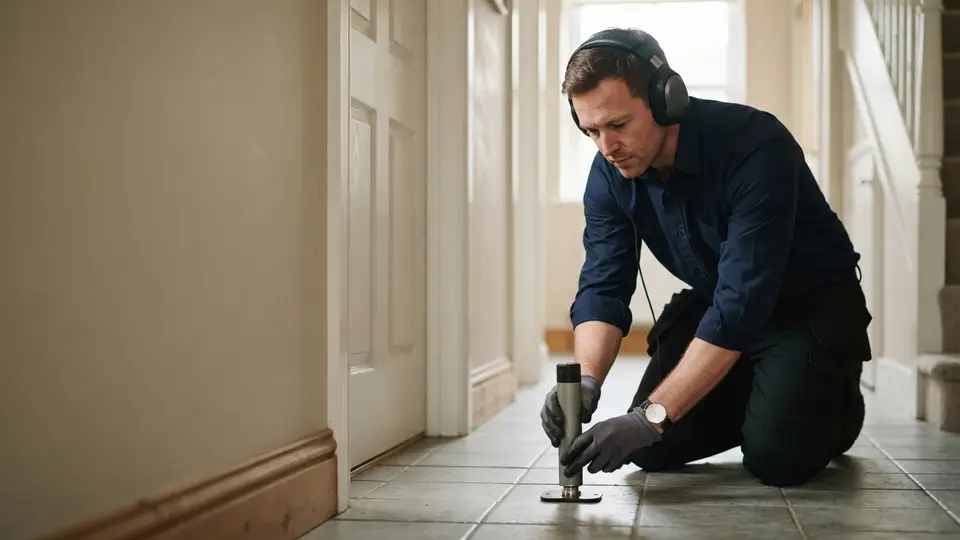
Meter check
What it tells us: Whether water is being lost
When we use it: Start of every call

Ceiling stain spreading, or a pipe that split in the cold? We handle leak detection and repair in Minnesota. Our plumbers locate hidden leaks in walls, ceilings, finished basements and buried lines, then fix them through small, clean openings. Minnesota winters are hard on plumbing: pipes freeze in exterior walls and garages, and frozen water services are common when frost runs deep. We also thaw frozen lines and repair burst pipes, then explain how to keep it from happening again.
The service
Hidden leaks travel. Water follows joists and pipes before it shows on a ceiling, and in a finished basement it can soak carpet pad for weeks without anyone noticing. With 53% of Minnesota homes built before 1980, older galvanized and copper lines are frequent sources, along with washer hoses, ice maker lines and water softener connections.
Our leak-finding methods
What it tells us: Whether water is being lost
When we use it: Start of every call
What it tells us: Which line is leaking
When we use it: Supply systems
What it tells us: Where water is escaping
When we use it: Walls, floors, buried lines
What it tells us: Wet or warm spots
When we use it: Ceilings and hot lines
What it tells us: How far water spread
When we use it: Drywall, framing, flooring
Why Minnesota
Below-zero stretches freeze pipes in outside walls, garages, porches and crawl spaces.
In hard winters frost can reach buried service lines and freeze them solid.
Old galvanized and copper wears thin, especially with hard water.
Hoses left on in fall split the faucet inside the wall.
Warning signs
Our process
We confirm the loss at the meter, isolate branches and pinpoint the spot with acoustic and thermal tools before cutting.
We open the smallest area needed, replace the bad section or fitting and pressure test it before closing.
We stop the water, replace the split pipe and check nearby sections for damage from the same freeze.
We locate the ice, thaw it safely, including frozen water services, and add insulation, heat cable or a new route as needed.
Typical cost
Leak repair prices are estimates only until we find the leak. These factors matter:
We explain the repair and you approve a written price before we open anything.
Get a written price: (833) 733-2357Some leaks take more testing to find.
Walls, ceilings, slabs or underground.
Thawing equipment and time.
Old pipe may need more than a patch.
After-hours calls cost more.
Benefits
We open walls in one place.
No more paying for lost water.
Wet areas found and dried sooner.
Helpful for insurance and associations.
In winters with deep frost and little snow, water services can freeze underground. Duluth (39,978 homes), Hibbing, Virginia and International Falls see this most, but Twin Cities homes are not immune. Cities sometimes ask residents on at-risk lines to keep water running at a pencil-thin stream. When a service freezes, we thaw it with equipment designed for buried lines, check for damage and, if it freezes repeatedly, discuss relaying it deeper.
Older houses in Minneapolis (209,080 homes) and St. Paul often have pipes near the rim joist, in exterior walls or in unheated porches. Hibbing, where 79% of homes predate 1980, and Virginia (83%) have many homes with the same weak spots. When we repair a freeze break, we also seal the draft that caused it and insulate or reroute the pipe.
Newer homes in Maple Grove (median year 1991) and Eden Prairie (1988) often have finished basements where supply lines, softeners and water heaters sit behind walls. A slow leak can soak a large area before it shows. We use moisture mapping and thermal imaging to find the source and open only what is needed.
Buildings with five or more units hold 57% of homes in Hopkins and 45% in St. Louis Park. Leaks travel between units and floors. We identify which unit or riser is leaking, document it for owners and associations and make the repair so drying can start.
In Crosslake, 59% of homes are seasonal in our data. A cabin that is not fully drained in fall can have splits in several places come spring. We winterize with air and antifreeze, open cabins in spring with a pressure test and repair any freeze damage. Leak sensors and remote temperature alerts help owners who leave heat on through winter.
One of the most common spring leaks is a frost-free sillcock that split because a hose was left attached. Water stays trapped in the valve body, freezes and cracks it inside the wall. It does not leak until the faucet is opened in spring. We replace the faucet and any damaged pipe and show you how to winterize it.
Every Minnesota winter, homeowners call us about ceiling stains that turn out to be ice dams, where melting snow backs up under the shingles and drips into the attic. Other times a roofer is called for what is really a leaking bathroom drain or a frozen pipe in an exterior wall. We test the plumbing first. If the supply lines hold pressure and the drains are tight, we tell you so and point you toward the roof, so you do not pay for plumbing work you do not need.
Close the main valve near the meter. If water is near outlets or fixtures, turn off that circuit if you can reach the panel on dry ground.
For a frozen pipe, open the faucet it feeds and warm the area gently, never with an open flame. Move belongings away from water, then call us.
Minor leak repairs typically need no permit, while repiping and service replacement do. We file permits with your city or the state when required. Our plumbers hold Minnesota plumbing licenses.
Why choose us
What you can count on every time one of our plumbers comes to your door.
Every job is handled by a plumber who holds the license your state or city requires, backed by liability insurance.
Our plumber explains the problem and the options, and you approve a written price before any work begins.
Burst pipes, sewage backups and failed water heaters get priority scheduling, including nights and weekends.
We pull permits when the job needs one and schedule the inspection, so the work holds up when you sell.
Repairs and installations come with a written warranty on labor, on top of the manufacturer's warranty on parts.
Our pages and plumbers account for your area's water, soil, climate and the age of the homes around you.
Service area
We find and repair leaks in 915 Minnesota communities, including St. Paul (133,051 homes), Rochester (54,492 homes) and International Falls (3,165 homes). Find yours:
It depends on how hidden the leak is and how much testing it takes. Once found, you get a written price for the repair.
Usually. One precise opening costs less than searching through several walls or ceilings.
Some policies cover locating a leak that caused covered damage. Check your policy; we provide the details your insurer needs.
We isolate branches with pressure tests, then pinpoint with acoustic sensors, thermal imaging and moisture readings.
Yes. We use equipment made for buried lines, then check for damage once water flows.
A hose left attached trapped water that froze and split the valve inside the wall. We replace it.
Yes. Soaked drywall can fall, and water near fixtures is an electrical hazard. Stay clear and cut power if safe.
No. Open flames start fires. Use gentle heat like a hair dryer on exposed pipe, or call us.
Most take one to a few hours once found. Frozen services and multiple splits take longer.
Often several days with fans and dehumidifiers. Carpet pad may need replacing.
If your city advises it, yes. A small steady stream keeps water moving in at-risk lines.
Yes, especially for cabins, finished basements and condos. Some shut off water automatically.
Shut the main valve, cut power near the water if safe and call us. Burst pipes are a priority.
Long stretches below zero reach pipes in exterior walls, garages and shallow services, especially in older homes.
Yes. We locate the leak and repair or replace the service, working with your city on the public side.